20 August 2017

The Monument 4: Removal

[Part 4 of a 4-part series]

Ten years ago I wrote a series for this blog, telling the story of the creation and dedication of the Chatham County Confederate Memorial, and of the aftermath, when the statue was defaced. Today I am updating this series, with two statements stripped of ambiguity or equivocation:

  • The Chatham County Confederate Memorial symbolizes the regime of racial apartheid that white supremacists brought to the South in the era of Jim Crow.
  • The memorial should be removed from its present place of veneration in the town of Pittsboro's public space.
I happened upon the story of the monument while doing research in the Chatham Record in July of 2007. It seemed an important one to tell, but with the memorial's centennial a few weeks away, there was no time for me to pitch the story to a publication and have it run to coincide with the anniversary. I created the Chatham Rabbit blog as a venue for that particular piece, which I posted soon after the centennial. After a few months, I left off and stopped updating the blog.

In the last week, the questions posed by monuments to the Confederacy have flared once again in the national discourse, as a response to violent displays of hatred by white nationalists. This time, the actions occurred in Charlottesville, but the same questions arose from the racially motivated murder of blacks in Charleston two years ago. There is an irredeemable bond between the monuments and the ongoing history of white supremacy in the United States. The questions will persist until we have reconciliation on race in America, and reconciliation is a long road that stretches before us.

What the memorial stands for

The Confederate monuments that went up in the early and mid-Twentieth Century are not memorials to defeat, but commemorations of a victory. The figures celebrate the final victory, in the states of the southern US, of the regime of racial apartheid that became known as Jim Crow.

In my piece ten years ago, I referred to the intentions of those who sought to place the monument in the space as "the movement to memorialize the Confederacy." I didn't take the statements of the monument's supporters at face value then; ten years of reflection on the state of race in America, and our lack of progress in reconciling with the atrocities of the past, have only deepened my skepticism. 

Today, I believe, there is much more widespread recognition of the true nature of these symbols. Many friends on social media during the past week have circulated a piece that historian Tim Tyson wrote for the News & Observer after the Charleston shooting two years ago, "Commemorating North Carolina’s anti-Confederate heritage, too." In it, Tyson (whose account of the relocation of the Confederate memorial in Oxford figured in my Part 3 ten years ago) wrote:
[T]hey built the monuments after the white supremacy campaigns had seized power by force and taken the vote from black North Carolinians. The monuments reflected that moment of white supremacist ascendency as much as they did the Confederate legacy.
Also following the Charleston murders, the Southern Poverty Law Center released a visualization of a timeline showing the placement of the Confederate monuments. It clearly shows spikes in the number of monument placements during the era of Jim Crow, and during the Civil Rights movement.

While there will always be a division of opinion on this point, I believe that the public debate is settled. The main question that follows is how we choose to act on this understanding.

What should happen next

The Chatham Confederate monument should be removed from a place of veneration in public space. If it is removed to a public space, it should be placed in a context that recognizes the ongoing history of white supremacy that the Confederacy, and its later memorialization in the Jim Crow era, represent.

The Board of Commissioners of the Town of Pittsboro should conduct a discussion on the proper course for removing the memorial. Just as the county's Board of Commissioners approved the placement of the monument in 1907, the town's board should register a decision to remove it. If necessary, funds should be raised from private citizens for its removal, just as was done for its creation 110 years ago.

Ten years ago, I also took a position on the removal of the monument:
[T]he monument no longer belongs at the center of civic affairs in the county. I think it should be moved, to a dignified memorial park where it can reside with memorials of a wide variety of origins. (Part 3)
I am less concerned now with the relocation of the monument to a "dignified memorial park," though I believe the county's historical museum - which resides in the courthouse building in the same circle - would, if feasible, be an appropriate place for it.

As of this writing, the news tells us that former mayor Randy Voller "appealed Monday [August 14] to the Pittsboro Board of Commissioners for a conversation about the monument’s future." When the minutes from the August 14 are posted, I will link to them here [Ed. 11/16/2018 - the minutes are here]. See the News & Observer of August 18, "Rumors bring group to aid of Pittsboro’s Confederate monument."

If the town moves to relocate the monument, it will do so in contravention of a bill that the NC state legislature passed two years ago, in a reactionary response to the discourse about monuments that accompanied the murders in Charleston. The General Assembly, in the time since Republicans took over in 2010, has proven itself hostile to the history of progressive change and leadership that is part of North Carolina's story. The Republican majority in NC currently engages in extreme practices limiting access to the ballot, providing a sad continuation of the regime of Jim Crow. Though federal courts have ordered the state to redraw its maps and hold special elections, the Republicans have refused to move forward in good faith. The Republican majority is not legitimate, and contravening its law forcing municipalities to maintain monuments should be considered an act of civil disobedience.

The name of the township in which Pittsboro lies is Center. The traffic circle in which the statue stands is the center of town, an important symbolic crossroads that lies near the geographical center of the NC. The statue stands in the center of public space in the town and the county. That shared, central space should represent our values, and speak of who we are and who we aspire to be. The people who lived here 110 years ago took this truth to heart, and acted on it by placing a memorial there to a lost cause that sought to preserve slavery, while themselves engaging in the suppression of equal representation for those whom the system of slavery and apartheid had wronged.

As long as the Confederate monument stands there in a position of veneration, the public space of Pittsboro cannot reflect the values to which we aspire. There's no loss to history if we choose to alter that space to do so. 

Will Sexton 
a.k.a. "Chatham Rabbit," ca. 2007
@willsexton
Pittsboro, North Carolina


14 November 2007

"The Chatham Rabbit" in Poetry. (Rabbit Lore #21, 1912)

As mentioned in Rabbit Lore #20, the Siler City GRIT of the 19-teens, then edited by Chatham RECORD editor Henry A. London's son, Isaac, published a rich body of rabbit-related material. For one thing, the paper compiled figures for exports of rabbits by consulting the local produce merchants on a weekly basis. Week-before-last we posted several examples of the GRIT's boilerplate announcement heralding the open of rabbit season.

The younger London took many approaches to his newspaper that his father did not, and in particular, stressed reader participation in the form of letters and doggerel verse. He featured a few regular correspondents, some of whom we'll be examining soon, but essentially turned the paper's editorial and "LOCALS" pages over to the public as a kind of proto-Chatlist. Reader, belly-up and help yourself to a taste of rabbit-themed poetry in this piece from the

Siler City GRIT, 1912 JAN 10, "'The Chatham Rabbit' in Poetry":
Once again are we permitting our readers the pleasure of scanning 'real poetry.' The following is from the pen of Mr. J.E. Smith. Who will be the next contributor?

"God bless old Chatham county;
God bless her endless bounty;
May her offspring and her sages,
Through endless, countless ages,
Be ever, ever blest.
Of her lads, they know their duty;
From the earth they dig their wealth;
Of her lasses, they have their beauty;
From her springs they drink their health;
None so truthful, none so fair.
Huckleberries and harvest cherries
And a bounteous crop of wheat,
The never-failing blackberries
That makes the pie so sweet;
Though they stain the ladies hand,
Yet there's plenty in the land.
Some are cooked with new-ground wheat
For us and all our hands;
Some by rosy lasses sweet,
For winter's use are canned.
September brings the pumpkin pie,
'Tis mighty hard to beat;
And Uncle Ned's o'possum, why
Is baked so good and sweet.
Of Chatham's greatest blessings,
All these will not compare
To one baked ham of the Chatham Rabbit,
Or dumplings, stew and dressings
Cooked with the Chatham hare.
Cook him as you will
Cook him as you may,
'Tis the same toothsome dish,
It don't matter what you say;
The old-time Chatham hare.
And, when my college life is done,
I'm going to my usual habit;
There to rub my rusty gun
And shoot the Chatham rabbit;
Me and Rattler and Trail.
Prophet, poet and sages
Will sing of them through ages
yet to come.

J.E. SMITH,
Wake Forest, Jan. 2nd.

11 November 2007

Trouble at Buckhorn (1906-1908)

[Photographs of the Buckhorn Dam site by the Rabbit. Satellite image of Buckhorn Dam via Google.]


View Larger Map

Chatham RECORD, 1906 JAN 25, "Local Records":

A gasolene launch has been put on the Cape Fear river and runs between Buckhorne and Lockville, a distance of about twelve miles. Since the completion of the dam at Buckhorne the water in the river between that point and Lockville is deep enough to float almost any kind of a steam boat.


Chatham RECORD, 1906 JUN 21, "Receivers for Cape Fear Power Co.":

From the Raleigh News and Observer, 15th [inst?].

In the United States Circuit court yesterday the Schenectady Trust Company, of Schenectady, N. York, filed a bill for foreclosure of the mortgage given by the Cape Fear Power Company, organized for the purpose of developing water power at Buckhorne Shoals in Chatham county, a few miles below Moncure, for the purpose of furnishing electric power to Fayetteville and other towns. The mortgage was made in 1903 to secure an issue of $350,000 of first mortgage bonds and the foreclosure is sought to be made on account of default in the payment of the April, 1905, October, 1905, and April, 1906, coupons amounting in the aggregate to $31,000.

Judge Purnell appointed as temporary receivers under a bond of $10,000 Messrs. Charles H. Belvin and E. Maxwell, who are directed to take immediate charge of the property and the defendant is notified to show cause on the 29th instant why their appointment should not be made permanent.

The Cape Fear Power Company is owned principally by Messrs. W.T. Morgan, of Fayetteville, and R. Percy Gray, of Greensboro, and purchased the water power at Buckhorne Shoals from the Deep River Manufacturing Company, the estate of the late Col. Heck and the Lobdell Company, of Wilmington, Delaware. It acquired a right of way from Buckhorne to Fayetteville a few years ago and built and equipped the line necessary for the transmission of power to that city. For some years it has been engaged in the construction of a dam across the Cape Fear and in building a power house at the site of the plant. It purchased large amounts of electrical machinery which has been delivered, but the most of which was never installed, being stored alongside the railroad tracks at Moncure awaiting the completion of the power house.

In view of the fact that the General Electrical Company is so largely interested in the bonds, it is hoped that it will either buy the property itself or form a new corporation to do so and complete the development of the power with a view of transmitting the same to Fayetteville and Raleigh and other cities.

Chatham RECORD, 1906 AUG 16, excerpted from "Superior Court.":
On the appearance docket are twenty-two cases against the Cape Fear Power Co. brought by some of the lands owners on the river between Lockville and the Buckhorne dam, because of the new dam backing water on their land. By an order of Judge Purnell all these cases are to be transferred to the Federal court at Raleigh for trial, as the Cape Fear Power Company is now in the charge of two receivers appointed by Judge Purnell.


Chatham RECORD, 1906 AUG 30, excerpted from the notice "Sale of Valuable Water Power and Electrical Plant.":

Under and by virture of an order of the United States Circuit Court for the Eastern District of North Carolina, Fourth Circuit, in the cause therein pending entitled Schenectady Trust Company against Cape Fear Power Company, dated the 23rd day of August, 1906, at 12 o'clock noon, at the door of the Court House of Chatham County at Pittsboro, N.C., expose to sale to the highest bidder at public auction, upon the terms hereinafter set forth, the property of the said Cape Fear Power Company, situated in Chatham, Harnett, Moore and Cumberland Counties, and described as follows, to-wit:

[...]

CHAS. H. BELVIN,
E. MAXWELL,
Receivers

R.T. GRAY,
Attorney,
Aug. 28, 1906

Chatham RECORD, 1906 SEP 6, "Dam A Nuisance.":

There is said to be an epidemic of chills and fever in Cape Fear township among the people residing on and near the Cape Fear river, between Lockville and the Buckhorne dam. This sickness is said to be caused by the backwater from the new dam of the Cape Fear Power Company, which has overflowed many thousand acres along the river banks. Such sickness was predicted and feared by the people of that section when the dam was being constructed, and their fears are now being realized.

Mr. Merrimon Harrington has sold his farm on the river and moved to Wake county, because of the sickness caused in his family by this backwater, and we hear that other citizens of that section are trying to sell out and move away. It is probable that the grand jury, at our November court, will be asked to indict the owners of the dam and have it torn down as a public nuisance.

Chatham RECORD, 1906 OCT 6, "Important Sale.":

In pursuance of the notice heretofore published in THE RECORD the receivers of the Cape Fear Power Company sold at public auction at this place, on last Saturday, all the property and rights of that company. The first bid was made by Mr. J.B. Blades, a wealthy lumber dealer from the eastern part of this State, who started the bidding at $120,000. The next bid was $125,000 by Mr. Henry F. Schaffner, of Winston-Salem. Mr. Blades then bid $130,000, whereupon Mr. S.D. Mitchell, a prominent electrician of New York, bid $250,000 in behalf of the bondholders and there being no higher bid the property was knocked down at this bid.

The property had been bonded to the amount of $350,000, so that it did not bring the amount due the bondholders. Not only do the bondholders lose heavily, but also the stockholders of the company who were the promoters of the undertaking have lost all that they invested in it. The company was organized several years ago for the purpose of constructing a dam across the Cape Fear river near Buckhorne falls (about twelve miles below Lockville) for the purpose of transmitting electric power to the cotton mills at Fayetteville, Sanford and other places. The dam was at last completed last winter, after many delays, but the electric power has not yet been developed, and it may cost $50,000 more to develop it.

This was the second most important sale ever held in this county. The most important sale before this was the sale of the property and rights of the old Cape Fear and Deep River Navigation Company, on the 26th of August, 1859, under a mortgage or deed of trust to the State of North Carolina to secure a loan of $300,000 made by the State to the company. The State became the purchaser at that sale through Gov. Ellis.

Chatham RECORD, 1907 JAN 24, "Local Records":
After an argument before Judge Purnell at Raleigh, on last Saturday, he refused a motion by the plaintiffs to remand to our superior court the damage suits brought against the Cape Fear Power Company by more than twenty landowners in this county, whose land is damaged by back-water caused by the big dam across Cape Fear river. Several of the suits have been compromised.

Chatham RECORD, 1907 MAR 28, "Buckhorne Electric Power.":
Special to the Charlotte Observer. Fayetteville, March 24. -- Mr. E.J. Maxwell, superintendent of the Cape Fear Electric Power Company, with an immense plant at Buckhorne Falls, was in town yesterday. He confidently states that he will have 3.500 or 4,000-horse power flashed by electric transmission to the industrial plants of Fayetteville by the 1st of next June. This is a "consummantion devoutly to be wished," but, to be plain, there has been so much "hope deferred" here about the Cape Fear company that we will wait and see it.

Chatham RECORD, 1907 APR 25, "FOUR MEN DROWNED":
Swept Over Buckhorne Dam.

Four men were drowned, on last Tuesday, at the Buckhorne dam in the Cape Fear river.

They were Capt. Thorson, the foreman of the works at Buckhorne, Mr. Emory A. Brady and two colored men, one name George Champion and the other Henry Lashley.

They and a colored man, named Joe Andrews, were in a gasolene boat that was in the river above the dam, carrying some lumber across the river, when the machinery got out of fix, or for some cause the boat got beyond control and began drifting with the strong current towards the dam. All efforts to stop the boat were in vain, and with accelerated motion it swept to the dam and plunged over, dashing the five men into the seething waters below.

Only one of them, Joe Andrews, escaped a watery grave. He was able to swim ashore, but the other four were drowned, and their bodies were swept down the river and may not be found for many days, if ever.

Capt. Thorson was a stranger who had been at Buckhorne only a few months. Mr. Brady was born and reared near Haywood, in this county, and had been empoyed for two or three years by the company building the dam. He was a son of Capt. Brady, who was the captain of the old steam boat that used to belong to the Cape Fear & Deep River Navigation Company.

This dam at Buckhorne was completed last year by the Cape Fear Power Company and its construction was so costly as to bankrupt that company, which went into the hands of receivers last summer by whom its property was all sold last fall. Its present owners will soon be able to utilize and transmit the electric power generated there to Fayetteville and other places.

Chatham RECORD, 1907 MAY 9, "Local Records":

On Monday morning about 70 feet of the dam of the Cape Fear Power Company at Buckhorne Falls was washed away. It will be replaced at once by concrete work, the part washed out being made of dirt.

Chatham RECORD, 1907 MAY 9, "Local Records":
The bodies of all four of the men, who were drowned at the Buckhorne dam, have been found and decently buried. They were found in the river near the place of the accident.

Chatham RECORD, 1907 MAY 23, "Local Records":
The recent breaking of the big Buckhorne dam on the Cape Fear river has greatly reduced the quantity of water in the river between Buckhorne and Lockville, in this county. The water is now so low in that part of the river that the gasolene boat can not run, as heretofore, between Buckhorne and Lockville.

Chatham RECORD, 1907 JUN 20, "Local Records":
There will be a Fourth of July celebration at the bridge across Buckhorne creek near the big dam across the Cape Fear river, in this county. In addition to speeches there will be all sorts of games and contests of an amusing character, and at night there will be a display of fireworks.

Chatham RECORD, 1907 SEP 5, "Fatal Flash":
During the storm last Tuesday a flash of lightning struck the cementhouse of the Cape Fear Power Company at Buchhorne dam and instantly killed 7 men and stunned 25 others. This was the most fatal flash of lightning that we ever before heard of in this county. The same storm reached this place and extended over most of this county, and it was not only an unusually violent electric storm but it was an unusually heavy fall of rain. The government rain-gauge, kept here by Mr. B. Nooe, showed a rain-fall of two inches and thirty hundreths of an inch. A feed trough of Mr. T.M. Bland, near here, was filled to the depth of three and a half inches by the rain. The heavy rain was accompanied with heavy crashes of thunder and blinding flashes of lightning. A tree was struck in the yard of John L. Council, of this place, and the shock shattered 42 panes of glass in the windows of his dwelling. A rain was greatly needed, the crops were suffering very much and the streams were all very low, but this storm rather over-did the thing.

Chatham RECORD, 1907 SEP 12, "Catastrophe at Buckhorne":

Later news from the fatal flash of lightning at Buckhorne does not decrease its horrors. As was published in last week's RECORD, a flash of lightning instantly killed seven men in the cement house of the Cape Fear Power Company. The lightning struck a tall poplar tree in a few feet of the cement house, in which the men had sought refuge from the rain, and then went through the roof of the building and did its fatal work.

There were twenty-one men in the building, seven were badly shocked and seven escaped injury. A horse was also in the building and it was not hurt, but was frantic with fright. One of the injured men was thought ot be fatally hurt, but is till alive. This terrible accident so demoralized the other men at work at Buckhorne that about one-half of them quit work and left there. Of course there is no more danger from lightning there than anywhere else, and there is an old saying that "lightning never strikes twice in the same place". It is said that about twenty men have lost their lives by accidents at this place since work was begun on the big dam several years ago. It will be remembered that a few months ago four men were carried over the dam in a boat and were drowned.

About fifty feet of the dam was washed away next day after the men were killed by lightning, which will delay for some time longer the completion of this important (and we may add unlucky) enterprise.

Chatham RECORD, 1907 SEP 12, "Local Records":
On last Thursday there were two peculiarly sad funerals at Zion Christian Church in Oakland township. They were the funerals Messrs. Eugene Black and Carlton Gunter, then young men of that neighborhood who were killed by lightning at the Buckhorne dam. They were popular young men, whose sudden and untimely deaths were a shock to all their friends.

Chatham RECORD, 1907 OCT 24, "Local Records":
The break in the dam a [sic] Buckhorne, which occurred several months ago, has at last been repaired and the electrical machinery is being conveyed down the river from Moncure and installed. It required five days for the river to fill up after the dam was repaired, the water being backed some distance up Haw and Deep rivers whose confluence form the Cape Fear nearly ten miles above the dam.

Chatham RECORD, 1908 JAN 8, "Water Power":
The great work of developing the water power at Buckhorne on Cape Fear River, in this county, is about completed and last week the electric power generated there was transmitted to Fayetteville for the first time. This work has been in progress several years and nearly half a million dollars have been expended on it. It is hoped that the valuable water power at Lockville, ten miles above Buckhorne, may be developed and utilized at no distant day. This power can be developed much cheaper than than [sic] at Buckhorne and is at present running idle and of no value to anybody. This property, which includes 2500 acres of land, is now owned by the Lockville N.C. Power Corporation most of whose stockholders reside at Richmond, Virginia.

Chatham RECORD, 1908 MAR 25, "Visit to Bucknorne Falls":

On Tuesday of last week the editor of THE RECORD, being one of a small party from this place, visited for the first time the electric power plant recently erected at Buckhorne Falls on the Cape Fear river in this county by the Cape Fear Power Company, now called the Central Carolina Power Company, and which was put in operation the 3rd of this month.

We were met at Moncure by "Commodore" M.T. Sturgeon in one of the company's gasoline launches and after a delightful ride of an hour were landed safely at the big 1200-foot concrete dam, from which point a walk of a mile brought us to the power-house. Here we were taken in charge by Mr. C.P. Stewart, the efficient superintendent, who courteously showed us over the plant, explaining the details of the mechanism, etc. In the equipment, all of which is of the latest pattern, are three alternating current generators each capable of generating 2300 volts of electricity, two exciters, one of which furnishes electric lights for the plant and premises at night, a continuous motor pump making 1700 revolutions a minute, and electric transformers carrying 60,000 electric volts.

The amount of power now available is [1,600?] horse power, although only 800 horse power is at present used, this being supplied to two cotton mills at Fayetteville 34 miles distant. In a few days a line will be surveyed to Raleigh, 26 miles away, looking toward furnishing that city with electric power and arrangements have already been made by industrial plants at Sanford to take a considerable quantity of the power.

An interesting feature in connection with this plant, and in fact all like plants, is that while its erection required the labor of several hundred men for months, yes years, the work having gotten started over five years ago, yet the services of only half a dozen men are required to operate it.

This electric power plant, which represents an expenditure from first to last of nearly half a million dollars, is by far the largest industrial concern in our county and we wish for it and its energetic general manager, Mr. Eugene Maxwell, through whose courtesy we are indebted for this enjoyable trip, the largest measure of success possible. The dam is 1200 feet long, 12 feet wide at the base and 14 feet high and is made of concrete. It is a few feet below the site of the old dam built before the war by the old Cape Fear & Deep River Navigation Company, and is eight miles below the railroad bridge at Moncure.

The trip from Moncure down the river to the dam was delightful, and was a [?] experience in this county. The river varies in depth from Moncure to the dam from ten feet to thirty feet and is a beautiful sheet of water, being over twice the width of the Cape Fear at Fayetteville. Two miles below Moncure is the "point," the confluence of the Deep and Haw rivers, where the Cape Fear River begins. At this point each of the two rivers seems to be about the same width. Two miles below the confluence of the Deep and Haw rivers is McKay's Island, half a mile long and containing about 65 acres. Two miles below that is Avent's ferry which has been in use ever since the county was organized in 1771 and has always since borne the same name. The ride down the river was made in less than an hour, and a more delightful spring day could not have been selected. The air was balmy, the water as smooth and calm as a mill pond and with a whirr the gasoline launch churned through the water, leaving rolling waves in its wake. The banks of the river were low and the country on each side quite level until the dam was reached, where the high hills arose abruptly on each side of the river, and the entire landscape was changed.

Chatham RECORD, 1908 AUG 12, "Local Records":
Quite a number of young people went form here last Wednesday to Buckhorn Falls on a picnic launch party and spent a most enjoyable day, thanks to the many courtesies extended them by Superintendent C.P. Stewart and Captain Eagle. Those composing the party were the following: Misses Alice Bynum, Elsie Williams, Betsey London, Mamie Elliot, of Linden, Jessie Crosswell, of Fayetteville, Josephine Boylan, of Raleigh, Annie Plummer Nicholson, of Washington, and Katherine Hawkins, of Jacksonville, Fla., and Messrs. Paul J. Barringer, H.M. London, F.W. Bynum, Jesse Milliken, Walter Jerome, Bennett Nooe, Isaac London and B.B. Pope, of Weldon.

10 November 2007

Pittsboro's Big Day (1907)

Chatham RECORD, "Local Records", 1907 MAR 14:
The height of human happiness is experienced by a child (and some grown folks) at a circus, and there will be many a happy one here next Tuesday enjoying Sparks' Shows.
Chatham RECORD, "Local Records", 1907 MAR 21:
A fairly large crowd for this season of the year witnessed the afternoon and night performances of Sparks' show here on last Tuesday. A special train brought the circus here at 3 o'clock in the morning, and at 12:30 the street parade took place, the chief attractions of which were the elephants and the ponies. All who attended the show seemed well pleased.

04 November 2007

Rabbit Lore #20 (1913)

The avatar this backwater blogger claims for himself now once practically served as a brand for the county. People inside Chatham county built snares for the rabbits and bred dogs to chase them; people outside the county identified the place and the people with a rare quality of rabbit that tasted particularly sweet and succulent. The Chatham rabbits swam in gravy on the table and converted readily to change for a boy's pocket, yet they remained untamed and elusive, humble but a delicacy on the most discriminating palates. Maybe the rabbit served as mascot for so long because the county was like that as a place, rustic and simple, difficult to get at, yet distinguished by a certain refinement of country living.

Since we began scampering in this blog-space we've taken care to note references to the eponymous bunny as we come upon them. These quotations went into a single ongoing post, "Rabbit Lore", and included items from the Chatham RECORD, but also the Washington Post and a transcript from the Southern Oral History Project. It was a delicious stew full of tasty bits of meat, but the problem was, the tiny link from the sidebar wasn't prominent enough.

I decided for this reason to break "Rabbit Lore" into individual posts. Now "Rabbit Lore" is a blogger label that ties the series together, and new Rabbit Lore items will appear as individual posts. Several were added in the last two days; the reader may notice the use of material from the Siler City GRIT. Chatham RECORD editor Henry A. London's Son Isaac published the GRIT 1904-1920. While reading the GRIT the lore of the Chatham rabbit crops up even more frequently than in the RECORD, including, as a closer to this post, this following advertisement from W.S. Durham, a produce merchant who bought rabbits for export.

Siler City GRIT, 1913 OCT 29:

Rabbit Lore #19 (1915)

Chatham RECORD, 1915 FEB 17, excerpted from "HELPS FOR HOMEMAKERS. Edited by the Extension Department of The State Normal Industrial College. -- Foods Prepared by Miss Minnie L. Jamison, Director Domestic Science Department. II -- CHEAP MEATS. THE CHEAPER CUTS OF MEAT.":

Rabbit Lore #18 (1913)

Siler City GRIT, 1913 OCT 29, "CHATHAM RABBIT.":
The cycle of Time has once again revolved, bringing an expectanct section into its own. Even as the ancients regarded the Ides of a month, so the toothsome Chatham Rabbit, had it the power of human understanding, would with fear and trembling regard the first of November. On that day begins the assault on Bre'er Rabbit, and with dog, gun and gum the prized animal is relentlessly pursued. Even as Kentuckyians think corn in the liquid state is nowhere else as mellow, so Chathamites know that nowhere else are rabbits so prolific or as delicious as in her own confines.

In truth, Siler City is the emproium for the things "of the earth, earthy." The tang of the early mornings are reminders that hair-triggers are springing, and, in two more weeks the b-r-r of the partridge will half scare a fellow to death. But Nov. 1st is here and the rabbits will get it in the neck.

In 1910, 19671 were shipped from Siler City; in 1911, the number was 16,573; in 1912, 26,060; and in 1913, $13,979 were shipped. These figures may appear unreal, but are accurate nevertheless. They were compiled on Tuesday afternoon of each week during the game seasons from the books of the produce dealers by the editor; hence we know whereof we speak.

Rabbit Lore #17 (1912)

Siler City GRIT, 1912 OCT 30, "CHATHAM RABBIT.":

The cycle of Time has once again revolved, bringing an expectanct section into its own. Even as the ancients regarded the Ides of a month, so the toothsome Chatham Rabbit, had it the power of human understanding, would with fear and trembling regard the first of November. On that day begins the assault on Bre'er Rabbit, and with dog, gun and gum the prized animal is relentlessly pursued. Even as Kentuckyians think corn in the liquid state is nowhere else as mellow, so Chathamites know that nowhere else are rabbits so prolific or as delicious as in her own confines.

In truth, Siler City is the emproium for the things "of the earth, earthy." The tang of the early mornings are reminders that hair-triggers are springing, and, in two more weeks the b-r-r of the partridge will half scare a fellow to death. But Nov. 1st is here and the rabbits will get it in the neck.

In 1910, 19671 were shipped from Siler City; in 1911, the number was 16,573; and in 1912, 26,060 were shipped. These figures may appear unreal, but are accurate nevertheless. They were compiled on Tuesday afternoon of each week during the game seasons from the books of the produce dealers by the editor; hence we know whereof we speak.

03 November 2007

Rabbit Lore #16 (1913)

Chatham RECORD, 1913 NOV 19, "Chatham's Rabbit Crop":
Editor of The Record:

I noticed in the News and Observer of last week that Mr. Hayes was in Raleigh and was speaking of Chatham’s unusually good crops, and being asked how the rabbit crop was this year, replied: "I think rabbits are scarce 'round Pittsboro as I haven't seen one this season there."

I wish to state that last Tuesday eve Mr. R. B. Bennett, of Baldwin township, "set" a box and upon going to it Wednesday morning found a nice, fat hare. He reset the box and Wednesday p.m., after dark, was near the box getting some wood and found the door down. On looking he found another. He reset again and found still another on Thursday morning—three rabbits in 36 hours. This is true, and we wish to state that we don’t want Chatham to get behind in the "old reliable" crop; neither do we wart to be-excelled in sweet potatoes. There are plenty of rabbits in Baldwin township.

G.G. WARD
Rt 1, Bynum. Nov. 17.

Rabbit Lore #15 (1914)

Chatham RECORD, 1914 NOV 18, "Chatham Rabbits":
From the News and Observer.

The famous Chatham county rabbits are finding their way to Raleigh and a number of the cafes of the city are serving them on their regu!ar bill of fare. Rabbits are one of the chief products of Chatham and have a wide reputation throughout the country. Raleigh people are very fond of the Chatham rabbit and it has been said that they consume so many of them during the fall and winter season that they gradually take on the "rabbit lope" when walking around on the terrestrial sphere.

30 October 2007

High Strangeness: Rambler's Skeleton (1913)

[Detail from "Danjuro V as a skeleton and Iwai Hanshiro IV as Princess Sakura in the Play 'Flower of Edo: an Ichikawa Saga,'" by Katsukawa Shunsho, 1783]

Just in time for All Hallows' Eve, and thanks to Rabbit, a spooky tale from our friend the Rambler [sic throughout]:
This story is used as an illustration of one on a most respected citizen of Pittsboro. This gentleman has a summer house not far from town and occasionally stays there at night. A few nights ago he became very interested in a story he was reading. He had pulled off his shoes and was enjoying himself hugely, when, without warning, came a voice from somewhere, saying: "Sam Jones! Are you going to die here or in Pittsboro?" Sam Jones looked up expecting to see someone but he did not. Again that same voice was heard, asking the same question. This time he saw the skeleton of a man standing at the window, the mouth at work, and the arms swinging to and fro. Who would have stayed around such a place? Not I. Neither did Sam Jones. When he reached town he was nearly out of breath, and a pale, deathly look was on his face. He had run the whole distance, a mile or more, in about three minutes.
Was there a Sam Jones, or someone to whom this pseudonym was applied? Was he the victim of a practical joke? It's not beyond the realm of possibility that ol' Rambler was somehow involved, high on "Life's Elixir." Pittsboro, after all, has always been a place that requires us to make our own fun. Tweaking one of Chatham's "elites" still has its pleasures. The piece from which this passage was extracted, dated 1 October 1913, contains other, more colloquial, ghost stories. This one is so unusual that it suggests either a real paranormal occurrence or, more likely, a rascally Rambler at work.

Attention: will the owner of the skeleton or a descendant of "Sam Jones" please contact the blog. Thank you. Oh, and please give generously this Halloween. One of those little skeletons at your door might be real.

29 October 2007

Google Rabbit

Lance Mannion, a blogger the Rabbit admires, takes up a meme which came to him along a chain four links long. Here's the premise from its originator, David Ng at World's Fair:
[Y]ou will attempt to find 5 statements, which if you were to type into google (preferably google.com, but we'll take the other country specific ones if need be), you'll find that you are returned with your blog as the number one hit.

[...]
To make it easier, we'll let you use a search statement enclosed in quotations - this is just to increase your chances of turning up as number one, but if you happen to have a website with the awesome traffic to command the same statement without quotations, then flaunt it baby!
A commenter to Ng's original post also suggests scoring a point for each of the total hits a phrase returns. So without prompting of any kind, I accept the challenge, and I'll include total hit counts as well as links to the individual posts that feature the phrases. Eschewing quotation marks, here are five phrases that -- on October 29, 2007 -- turn up the Chatham Rabbit blog as the first hit in a Google search:

1. chatham rabbit, 273,000 hits, links to the home page

2. chicken eats flies, 1,720,000 hits, "Chicken Eats Flies" (1913)

3. treacly ante-bellum, 195 hits, Erasing the Stone Tape

4. one of the most disgraceful acts of vandalism, 76,600 hits, The Monument 3: Symbol

5. character impersonations, humorous songs, 473,000 hits, Vaudeville comes to Pittsboro (1909-1910)

I also found it interesting that the phrase shower of blood fell around her turned up, as #2, this blog's home page and tommy yum's High Strangeness: Blood Fall (1884), behind the anomalist's article which describes the very same incident. And yet, tommy yum quotes the passage precisely from the Chatham RECORD article while the anomalist only echoes it. Hit #4 for
shower of blood fell around her links in a Google books version of the poems of Ossian, containing this rather terrifying passage:
The night passed away in song; morning returned in joy. The mountains showed their gray heads; the blue face of ocean smiled. The white wave is seen tumbling round the distant rock; a mist rose slowly from the lake. It came in the figure of аn aged man along the silent plain. Its large limbs did not move in steps, for a ghost supported it in mid air. It came towards Selma's hall and dissolved in a shower of blood .
Which seems to portend the death of the people. Wow, I'll be seeing that one in my sleep tonight. But I digress! Hurrah for
Old Capt. Crump's yardbird earning the #1 Google standing for the phrase chicken eats flies over more than 1,700,000 hits. She may have died suddenly, but her memory lives on for everyone who enters chicken eats flies into Google.

28 October 2007

Rambler #5 (1914)

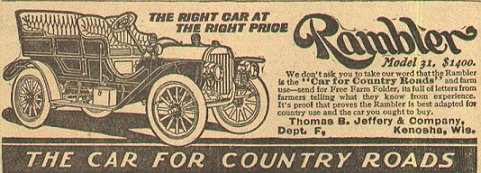
[Image of the 1908 Rambler advertisement linked from the Wikipedia commons. See also the article on the Rambler.]

The fifth and final installment in the "Rambler's Musings" series, published in the Chatham RECORD on Feburary 18, 1914, follows:
RAMBLER'S MUSINGS. No. 5.

Is it not aggravating for a man to sit down and build air castles and then have a puff of wind blow them into a thousand pieces? That's what Rambler did, or rather let his imagination take him a hundred years ahead to see the "new" Pittsboro. What he thought he saw was enough to make most any of the people here today wish they could live that long. But it is not to be and although one hundred years from today Pittsboro may have a population of 50,000 souls, may have factories, paved streets, trolley lines and everything up to date, not a living soul here today will be here then. Every single person -- man, woman, child -- will be dead and forgotten.

Then while we are living today why not let us make the best of it? Let us get some of the pleasures and advantages that the people a hundred years hence will be enjoying.

Other towns are growing, why not this one? People here want industries to come; they want people to move here; they want paved streets and they want good roads leading into town.

But strange as it may seem and bad as they wish for these things, some of them put a check to the growth of the town when a person proposes to buy land and bulk here. If you buy my land, they say, you must pay for it. I don't blame a man for trying to get all he can for his land. It is natural that he'd want to do so, but there are times and places where a little foresight could be used in reducing their property value. It would be. more beneficial to them In the long run, help reduce their taxes, fill up the vacant places and cause Pittsboro to start to grow. Some people never stop to think of old man Malaga Grapes. He owned land, had money, horses, everything, and he probably thought he'd take it with him -- BUT HE DID NOT.

Tell me why dirt in Pittsboro should be priced so high and I'll tell you why there is no money at the end of a rainbow.

If Pittsboro was filled with manufacturing plants; if it even had a population of 10,000; if it had electric lights, paved streets, water, sewerage and no hog pens, people might have some cause for raising the price of their property, and unless property owners place a fair value on their lots people will not come here, nor will any enterprises, which so many people crave, ever be started here, and the owners of these high-priced lot will go the way of their fathers. It is true it can be left to their children. Malaga Grapes did that very thing.

Rambler knows of a case where the owner of 300 acres of land is od and feeble. He cannot work. But before he'd sell that land for $4,000, which he has been ofered, and place the noney at interest he rents it for the magnificent sum of $90 and has to pay the taxes on it.

Why not cut up his big farm into fifty acre plots, if he does not care to sell, and rent them out. He could get at least $25 a year for each farm and there would be six ears of corn grown whre only one is grown now.

"Everybody to his own notion," said the groundhog, as he went into his hole to escape the snowstorm.

RAMBLER.

22 October 2007

Rambler #4 (1914)

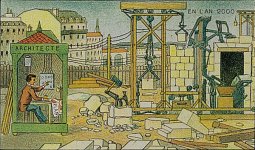
[The images L'avenue de l'Opéra and Chantier de construction électrique linked from Visions de l'an 2000, a 1910 series depicting life in the year 2000. From a digital exhibition of the National Library of France, hat-tip to the remarkable time-sink of a blog, Paleo-Future, "A look into the future that never was," and to tommy yum, who showed it to me.]

We continue here with #4 in the series of five numbered columns written for the Chatham RECORD by a pseudonymous "Rambler" in the opening months of 1914. In this installment [skip to it], published in the RECORD on January 28, 1914, Rambler imagines himself a Rip van Winkle falling into a hundred-years' sleep in the woods beyond Roberson Creek, then awaking to a vision of Pittsboro in the year 2014. It's an interesting bit of local speculative narrative, and probably the main reason why I chose to reprint the Rambler series.

Revisiting attempts from past eras to predict the future involves us in a kind of negotiation between things familiar and alien. There's a certain pleasure that arises when we see human needs that seem obvious and enduring get "solved" by innovations in obsolete technologies. So when the marvelous blog Paleo-Future shows us an advertisement for a wireless phone from 1910, we instinctively love it, in part because the functional need for a wireless telephone asserts itself as so obvious and eternal, and in part because the apparatus seems somehow to require an umbrella.

When Rambler talks of flying above a Pittsboro that spreads five miles south and north to the Haw River, well, he's not far off from what we're likely to see in 2014, even if he doesn't quite have the details right. His map grid of 991 numbered streets seems whimsical, but his overall vision of a boom has a ring of prescience to it. The projection of 50,000 people matches the entire county's population at the 2000 census, but seems on target for the northeastern quadrant of the county over the next decade or so. Bynum may not have a population of 3000 in the year 2014, but the Briar Chapel development resides in its township of Baldwin, and very well could. The train tracks no longer run through Pittsboro, and public transportation has no reach in town, but if we cup our ears and mute the TV we we might hear echoes in our bio-diesel boomlet of Rambler's invocation of cars (and tri- and unicycles) powered by electricity.

Part of the piece's appeal is Rambler's fixing his vision in the year 2014, which lies just ahead of us in our own future, imminent enough that our own planning cycles encompass it. This past weekend, news came via a political pamphlet left on my doorstep of "unprecedented development pressures making the Tues., Nov. 6 town election one of the most important in county history." The flier from Pittsboro Together has emblazoned in large, bold type across the front a word the Rambler could relate to: imagine. And yet, these smart-growthers do not bring visions of flying cars. They ask us to imagine, instead, "if Pittsboro became like Cary..." For readers beyond the Triangle area of North Carolina, "Cary" is a nearby Piedmont municipality said to be so overfed on sprawl that it stands as shorthand for the ultimate in suburban dystopia. On the one hand, who doesn't want a prosperous town? On the other hand, no one seems to want Cary.

I think Rambler would delight to see the Pittsboro of 2007 grown ripe with the fruits of technology and population growth: paved streets and a visible, uniformed police force to name two that he cites, and while they might seem humble in a place like Cary, I think he'd agree that our shiny new co-op, microbrewery and big box hardware store qualify as the "magnificent stores" he mentions; more of the same is surely on the way. But he would find the terms of the discussion to be very different than in 1914. It's easy to love the idea of a prosperous Pittsboro, but hard to see how prosperity lasts unless it's balanced with sustainable living and long-range planning. The industrial age is over; human- and rabbitkind produce more and we also consume more than in our youth. Somewhere we as a, um, people crossed a threshold into middle age, and the dreams of the Rambler lose some of their charm.

Still, I think it's fair for a Rabbit to ask: where's my flying car?

"Rambler's Musings No. 4" (January 28, 1914) follows; see below for more about the Rambler.
RAMBLER'S MUSINGS. No. 4.
Editor of The Record:

Rambler has talked of building dwelling houses, cotton mills and manufacturing plants. This week he is going to take you a hundred years ahead. In other words, in imgination, he is going to sleep and not wake up until the year 2014. If the reader will let his imagination run ahead for a hundred years he will be able to see Pittsboro in a new light.

* * * * * * *
Gracious! I feel tough. This has been the longest night I believe I ever saw. What am I doing over here in these woods? Have I been drunk and wandered away out here to keep anyone from seeing me? Gosh! There's a lot of fuss going on over in town. Listen at the steam whistles. Capt. Alson must be going. out. No, that’s not his train. There goes another whistle. And listen at the bells. I never heard the sound of bells like that before. Why, that sounds like a street car! What's the matter with me?

I got up on my feet and looked around. Where am I? What's the name, of this place? I never saw this town before. I am going to find, out where I am. Yonder is the railroad. Look at the tracks! I've been asleep here all night, but all those tracks were not there yesterday. I take up the railroad. Why, here's Robertson creek and this place must be Pittsboro. It is, I am told, but look at the new street, and the houses built up alongside the creek, and they extend as far as I can see. What's the matter with the place. It wasn't that way yesterday. I am drunk again, and lost. I'll nave to tell Mrs. Rambler another big ghost story.

I come to a street crossing. A sign on the corner reads "First street, East." I take up that street and go west about four blocks. Stores to the right; stores to the left. This cannot be Pittsboro. Yes, that is what it is, was the answer a blue-coated policeman gave me. Am I dreaming? No, I am wide awake. I look down at my feet; I move them; I am not asleep.

I finally reach one of the principal streets, I guess, as there were thousands of people walking the sidewalks. In the road way were all sorts of vehicles, all run by electricity. Some had two wheels, some three and some with only one wheel. Some of these vehicles were loaded with merchandise and some with people. Everything was moving. Hello! there comes a street car! Yonder is another one crossing the street. I stand bewildered -- lost. I knew I was in Pittsboro yesterday. There is the monument over there, but where is Manly Smith's wooden building? Look at the magnificent stores; and the streets are all paved. They have policemen in uniforms. Pete Gunter did not have a uniform yesterday. This can't be Pittsboro.

I wander up the street further. Hello! there's a printing office. I believe I'll go in. On a table lies a pile of papers. No one is in the room. I pick up a paper and look at it. It is the Chatham Record, dated January 25th, 2014! It was January 25th, 1914, when I wandered over to the woods beyond Robertson creek and laid down and went to sleep -- just 100 years ago today. And I thought it was yesterday.

Rip Van Winkle slept 20 years and I have slept 100!

While looking over the thirty-two pages of The Record a gentleman entered the room. He was a fat, chunky man and wore a cap -- it was Col. Bruce Poe. I recollected him in a minute. He recognized me too.

After talking over bygone days I asked the colonel how it was he had lived so long and was looking so healthy. "Why," he says, "you recollect away back yonder Capt. John Crump had a preparation -- a powder -- called "Life's Elixir?" You know it was said at the time it would prolong a man's life hundreds of years. Well, there was only three men in town outside myself that used that powder, and that was Col. Dr. Pilkington, Capt. Crump and Col. Fletcher Mann. The doctor," he continued, "is still in the drug business when he is on the ground. Col. Mann is in business at 592 West 742d street. He has been married five or six times and, you wouldn't believe it, but he is looking for another wife. Capt. Crump is working for the telephone company. He fell off a pole two or three days ago and broke a leg, but he put some of his powder on it and he is all right.now. I think he flew over to Raleigh this morning in his bird car."

Hundreds of other questions were asked the colonel about former citizens, but they were all dead.

Then he took us out to his bird house. He does not deal in Ford cars now but is a birdite. His bird, as he called it, was in the shape of an eagle; had the head, the tail, the appearance of a bird. I was asked to step inside. I was afraid, but I got in and sat down. I wish I could describe my feelings but have not got the space. He touched a spring, there was a flutter or two and the car sailed gracefully in the air. It was fine -- grand. We were about a mile in the air when we espied a car coming towards us. "Here comes Pilk now," he said. In a moment the two cars stopped alongsde [sic] of each other. We shook hands, talked a few minutes and separated.

The air was full of cars. Any way you'd look you'd see them.

Here I got good view of Pittsboro. From where the old courthouse used to stand (a magnificent one stood there now) the streets going north and south were avenues. The cross streets are numbered from First street to 991st and extend from Haw river on the east to Rocky river on the west. The avenues extend from five miles on the south to Bynum on the north. Bynum has a population of 3,000. On Haw river could be seen the big power plant.

And all this space was filled with residences, mills, factories and 50,000 busy people.

Thirty eight electric passenger trains alone stopped at the union station daily.

There are three daily papers printed in the city.

The town has grown some within the last hundred years, remarked the colonel, as we stepped upon the ground.

RAMBLER
When I opened the series, I had found no other columns by Rambler, but further research has turned up more of his writings. The numbered series of "Rambler's Musings" that began in January 1914 seems to have cut off at #5 in February, 1914; but Rambler wrote to the RECORD on numerous other occasions. The "Musings" series focuses on a vision for the development of Pittsboro, while Rambler's earlier columns tended to pass along local anecdotes, gossip, folklore and tall tales.

In "Musings" #4, Rambler goes off an extended tangent treating the "Life's Elixir" powder invented by a Capt. Crump of Pittsboro. As it happens, a piece appears in the Chatham RECORD of July 2, 1913, which relates a tall-tale or two about "Life's Elixir"; unfortunately, my current copy of the issue cuts the "Pittsboro Inventors" piece off and right now I can reprint it only in part, also below. I'll update this post with the full version at the earliest opportunity, but I'd have to say I'm about 99% certain it also came from the pen of the Rambler. It echoes his style, and also features prominently the figure of "Col. Bruce Poe".
Pittsboro Inventors.

While Pittsboro as a town cannot claim as many noted things as some other towns in this State, it has nevertheless some smart inventors. Among them is Capt. J. J. Crump, the inventor of the cross-cut saw, the hobby horse the see-saw and other useful things.

The captain once invented a horse-shoe that was put on without nails, but it did not prove much of a success, as the glue would get damp and the shoe drop off.

His latest realization of a success was a powder, which is composed of several ingredients. This powder he calls "Life’s Elixir," and is good for man or beast. To prove its efficacy as a milk producer and cow fattener, I will state the following facts:

Col. Bruce Poe, one of the finest gardeners in this State, the man who raised Irish potatoes so large and they grew so fast that they pushed his fence several inches from the line, bought a cow from Col. Bob Glenn. It was a small cow, but Col. Glenn said he'd guarantee that the cow would give a quart of milk a day. Col. Poe knowing the wonderful effects of Capt. Cramp's powder, bought five cents worth of it. Before giving the cow any powder he milked her for the first time that evening and she gave her usual amount, a pint. After milking he gave her more feed and a tablespoonful of the powder. The next morning the colonel went out to milk his cow (the colonel is a fine milker and delights in the pastime). He noticed that the cow had grown considerably larger, but he begin to milk and sing (he always would sing while at work) and the milk began to flow, slowly at first, but faster. Soon his pails were full and he called for more vessels. In a few minutes they were full and more buckets were culled for. The colonel had quit singing; consternation was depicted on his face. "Bring me some tubs," he called out in alarm, "this cow is raining milk." The tubs were soon full; in fact, everything that would hold milk was full, and still the end was not in sight. "Go and tell Capt. Minor to come here," said the colonel, excitedly. "What do you want with him," he was asked. "I want to rent the water tank over at the oil mill." Just then the sluice of milk began to cease -- the cow had been milked dry.

On feeding the cow that night (she was not milked any more that day) she was given another tablespoonful of the powder, and that was the colonel’s undoing. During the night the cow had grown so fast that she had pushed down the fence and next morning was gone. The colonel has never seen her since.

[Cont'd]

21 October 2007

High Strangeness: Watch the Skies!


[UFO image from crowdedskies.com.]

More Blood Fall goodness on the way, I assure you. But let's contemplate what else exists in Chatham's skies. I'm delighted to let reader Martha share her story with you, as it was emailed to me:

My sister and I were driving back from Chapel Hill late at night after seeing a movie I think. I want to say it was Good Morning Vietnam. It wasn't horribly late, but late enough, and in those days far fewer people lived out Jones Ferry Rd. in Chatham County so there was very little traffic. Just after we crossed over University Lake and were heading out of town, we noticed a very bright white light in the distance hovering at tree level. We talked about what it could be and speculated about it being the new WUNC TV tower that had gone up across from Story Book Farm. At the time, the large white tower was rather new and it was an eyesore because it blinked so brightly. However, the bright light on this evening was not blinking. As we drove, the light stayed stationary in the distance. We passed Story Book Farm and the blinking tower and the bright light was still ahead of us. Of course, now we were really wondering what was up. A helicopter with a search light on it. maybe? That was the best we could come up with, but given that is didn't move at all it seemed somewhat unlikely. When we came to Frosty's we pulled into the empty parking. The store was closed for the night. We stopped the car and turned the car off. The object with the bright white light shining down was right above the intersection of Crawford Dairy Rd. and Jones Fairy Rd. We rolled down the windows and it was completely silent. So silent you could hear the crickets and cicadas making their summer racket. Definitely not a helicopter. As we both sat there and looked at this thing (I recall it as being rather triangular-shaped like something from Star Wars, but my sister recalls it being saucer shaped), I'm not even sure we said anything to each other. We just stared. And then quickly, the light went off, the engines of the ship powered up (but weren't horribly loud when they did), and it took off really fast into the sky. It all lasted probably less than a minute or so.

So that's it. Never seen a UFO since. And have never figured out why one would be hanging out where this one was. Talk about boring. Maybe it was looking for the Big Hole over off of 54 and was checking the map.
She added this, in response to my queries:

The engines I guess sounded like jet engines gearing up, but not nearly as loud or deafening as that. And it took off very fast. The "ship" itself was not that large. Larger than a trash can though. Maybe the size of a reasonably sized room in a house. 50 X 50 ft? 30 X 30? Not small, but not huge by any means.


What are we to make of this? I don't know. The trash can reference is to a story I related to Martha, in which some friends of mine were chased by a trash-can shaped object as they drove their van to the beach. The object rose up from under an overpass and pursued them at speed for some miles before disengaging.

20 October 2007

Rambler #3 (1914)

[Image of auto stuck in the mud from the National Museum of American History's "America on the Move" exhibit.]

The Rambler series continues with #3, from the Chatham RECORD of January 21, 1914:
RAMBLER'S MUSINGS.
No. 3.

Editor of The Record:

Last week we talked on a cotton mill and house-building. We are going to talk about something this week that Rambler hopes will interest you.

Did you ever see a horse and wagon stalled in the mud? No matter how hard the horse pulled he could not move the wagon. All sorts of advice would be given the driver only to fail moving the load. The horse just could not budge it until a lot of husky fellows gathered around the wagon and put their shoulders to the wheel.

It moved then, didn’t it? You bet. So it is with some towns. A town will get into a rut. A few spasmodic efforts will be made to get it out by some of the more enterprising citizens, then a few more little jerks and pulls until it finally looks as if the poor old town was gone for sure.

But some day another kind of a fellow comes along and he sees the old town, and he also sees how bad she is stuck in the rut. He likes the looks of the place. it seems good to him. The people are clever, sociable and entertaining and he asks himself: "Why is this thus? Why don’t these people get on the main line?" And the more he studies over the question the more it puzzles him. He pulls off his coat and goes to work. He talks to this business man and that. He talks to the citizen. He tells them the advantages of such and such a thing; how it would benefit them, and not only them but others. The eyes of these people are opened. They, too, get to work and the result is the old town is MADE to get out of the rut. New life is taken on, new people move in, new enterprises come in, business gets on a boom, new stores and new residences begin to spring up, everything begins to flourish and everybody carries a happy face.

This is not an overdrawn picture. The town of Pittsboro has been in a rut for many years. Time and time and time again have some of its citizens tried to get it out, but the more they pulled the deeper it seemed to sink, until they gave up in disgust and despair.

Now there is yet a chance to get the old town back on its feet again, but every man must put his shoulder to the wheel and PUSH. IF YOU CANNOT PUSH, PULL. If you cannot do either don’t get in the way. LET'S ORGANIZE A CHAMBER OF COMMERCE. That will be the husky fellow to pull us out of the rut. Let the citizens get together and talk the matter over. "Argufy" the matter, as it were. There are plenty of public-spirited citizens here, and there may be some in the county who have not lost all pride for their county capital, that would join. Who knows but what such a movement, if conducted on the right line, would not be a stepping stone for the people of today to leave to future generations. Let's try it anyhow.

RAMBLER.

16 October 2007

Rambler #2 (1914)


Continuing the Rambler series, #2, from the Chatham RECORD of January 14, 1914, follows:
RAMBLER GETS TO MUSING.
No. 2


Editor of The Record:

The story printed in last week’s Record about old man Malaga Grapes is no joke and has a moral. It shows that man, no matter how rich he may be of this world's goods, when he dies he is brought down to a level with the poorest on earth.

Then why should a man toil and struggle, hoard and save for others? Would it not be better for him, for his family, for his county and for the people in general if he had taken only a part of his savings and put it into some manufacturing plant, where it would not only have helped him but also helped many others. You have got to die. There is no getting around that point, and it is a fact beyond question, that you cannot take your money with you. Then let Rambler offer some suggestions.

We are not talking particularly to the people of Pittsboro but to the whole county. It is the duty of every citizen in his county to take some pride in his capital city. Pittsboro has stood here for lo these many years. It seems to have got stuck here, and it needs the help of the business man, the farmer and all others who have any pride at all for their county seat to come to its rescue and pull it out of its present condition.

There are vacant lots galore here that need the hand of man to better improve them. Pittsboro needs houses. Here is the place where thousands of dollars could be invested that would pay the investors at least from 6 to 10 per cent and probably more. There are half a dozen families here today that would be glad of the chance to rent four or five room houses, but they are not here. People would come here to live if they could get houses, but they cannot get them and they move to other towns. Then again, how can you expect manufacutring plants to come into a town when the people do not seem to care whether there are any houses or not.

Every little business helps. Look at the hosiery mill here. Though small, yet several thousand dollars a year is spent among the merchants and others. Look how many thousands of dollars have been paid out by the Chatham oil company, by the Nooe planing mills and other works.

Pittsboro has a splendid school, excellent teachers and the healthfulness of the town cannot be surpassed. It could be made a fine winter resort if it was pushed in that direction. Don't say "Shucks! Pittsboro will never be more than it is. It's dead already." No wonder, when some of its own citizens continue to knock it in such a manner.

Pittsboro is not dead by any means, notwithstanding its hard knocks and kicks. Let the enterprising business men of the county and town put their heads together and invest their surplus in a cotton mill, or a wagon factory, or a chair factory or some other kind of a plant. LET 1914 BE AN EYE-OPENER to the Jonahs.

Have some pride in your county capital. One hundred men in Chathazn could easily raise $100,000 for a cotton mill, and Pittsboro is the logical place for it. There are the railroad facilities here, and sooner or later another railroad will be built through here, and there are two of the best sites here for a cotton factory that can be found in the state.

The monied men of this county might think seriously of this project to their own advantage as well as to the community.

Remember, six feet of earth is all you will have when you are dead, and you will be dead along time. Then leave something behind you to benefit humanity.

The clock has struck 1914, men. Let's get to work.

RAMBLER.

Rambler #1 (1914)

This blog is a prequel. The idea of the Chatham Rabbit hatched as a way to connect the backstory of Chatham County, North Carolina to its doozy of an emerging narrative. In the current story, a fable for our troubled times, a sleepy little backwater county wakes up at the turn of the 20th Century to find an array of powerful and not-so-powerful interests contending for its soul. As the place's landscape, populace and social life transform under intense growth pressure, its core story follows, like it or not (and some do and some don't) the expanding course of residential development. The blog does a small mammal's mite to save some fragments of memory before that flood.

Now, when one takes on such a project, and heads to the library and into the field to do some research, all kinds of stuff can turn up worth writing about. In this space we've shared nuggets harvested from a range of sources, particularly the county's long-running newspaper, the Chatham RECORD (est. 1877). The Rabbit has relayed stories of love and marriage, community life, and the lore of the rabbit. Fellow traveler tommy yum has written of High Strangeness. We cast a wide net here, it's all wholly within scope, and we think it's all worth knowing, for while this document is about land and its use, it's also about place. Furthermore, rabbits love stories, plain and simple, and find it impossible to resist their trails arrayed like so many cabbage rows across the gardens.

But with all the dallying in the ways of lovers and horse-traders and blockaders, it's well-nigh time to take up in earnest the story we originally set out to tell, the one where the land acts as a character. Debates over land use are nothing new to this space that has been a county for 226 years, and so the Rabbit will feature some of those discussions as they appeared in the Chatham RECORD and elsewhere a century or so ago. I'll begin with the series of pseudonymous columns penned by a self-styled "Rambler" in the RECORD beginning in January of 1914.

I'm not sure who the Rambler was, and if any readers can provide information regarding the person's identity, please contact me at precept6@yahoo.com. So far in my research Rambler's trail goes cold after five columns, but those five provide a departure point for an analysis of views of land use in the early modern age. They also keenly express a vision for Pittsboro that some will find interesting to read.

I'll reprint all five of the Rambler's columns over the next week or so. In the first column, the author lays out what we might call a moral basis for development. It's something we all do, and as Exhibit A I offer the Rambler, whose own moral the reader will discern from the first of the series, from January 7, 1914.
RAMBLER GETS TO MUSING.
No. 1.

Editor of The Record

Old man Malaga Grapes is dead. Malaga is not his correct name. Neither is grapes, but it answers all purposes. But Malaga is dead and buried. Over in the cemetery where MaLaga's body is lying there are several othet bodies nearby. Over on the left is a grave that contains a pauper. The pauper is dead, too, else they would not have buried him. Over to the right is the grave of a woman. This female was a great talker. She talked about her neighbors until they shunned her; she talked about her church members until she was turned out of church. When she had nothing else to talk about she talked about the cat. This woman was a tale-bearer, the worst of all women. So one day she died because her breath gave out and she could not work up enough wind to start her to talking again. So she was buried quite near Malaga Grapes' grave.

In another grave a thief lay. Other graves around Malaga's grave contained different kinds of people -- some good, some bad, others worse. Malaga did not care because he was dead too.

Malaga had worked hard all his life; had saved his money, stinted himself, eat half enough, and the coat he wore to town was the coat he wore year-before-last and-year-before-that-year's-coat; it would do for him, he said, for next year and year after. It was too good to throw away. And he kept on wearing that coat every day and Sunday too.

Malaga had money. He was worth half a million dollars. He had land, stock -- everything to make a sensible man happy. With all his money, with all his land, with all his stock -- he was dead and buried -- surrounded by a thief, a pauper and tale-bearing woman.

Malaga had nothing now. Neither did those other three. All were equal.

Malaga's wife died years ago, probably from starvation or a broken heart, but he kept on working and hoarding and saving until he reached the half a million goal. Then he died.

What became of all of Malaga's money, cattle and land? His only son fell heir to it and today he is living a profligate's life; smoking high priced cigars, drinking $5 bottles of champagne and wearing fine clothes.

What a different tale could have been told if old Malaga Grapes had taken $100,000 of that money, come to Pitssboro and put it into a cotton mill. He would have given work to hundreds of people; he would have helped to build up the town; he would have been looked upon as a good man. The worker would have spent his money with the merchant; the merchant would have improved his store and stock; the churches, the town and the county generally would have been benefited.

But, no. Malaga Grapes, like many other men with money and lands, did not see it in that light and hoarded his money and starved himself so others might reap the benefit.

You can save and pile up your riches but old Father Time will get you in the end and, so far as your money is concerned, the old shacks you leave will remain old shacks; the idle land will continue idle, and you are dead, having passed through this world not benefitting yourself or mankind.

If you have money put it into something that will help humanity. Take lessons from the Cones; take lessons from other philanthropic men and do likewise.

Remember only six feet of earth belongs to you and you can not take your money with you.

RAMBLER.