30 October 2007

High Strangeness: Rambler's Skeleton (1913)

[Detail from "Danjuro V as a skeleton and Iwai Hanshiro IV as Princess Sakura in the Play 'Flower of Edo: an Ichikawa Saga,'" by Katsukawa Shunsho, 1783]

Just in time for All Hallows' Eve, and thanks to Rabbit, a spooky tale from our friend the Rambler [sic throughout]:
This story is used as an illustration of one on a most respected citizen of Pittsboro. This gentleman has a summer house not far from town and occasionally stays there at night. A few nights ago he became very interested in a story he was reading. He had pulled off his shoes and was enjoying himself hugely, when, without warning, came a voice from somewhere, saying: "Sam Jones! Are you going to die here or in Pittsboro?" Sam Jones looked up expecting to see someone but he did not. Again that same voice was heard, asking the same question. This time he saw the skeleton of a man standing at the window, the mouth at work, and the arms swinging to and fro. Who would have stayed around such a place? Not I. Neither did Sam Jones. When he reached town he was nearly out of breath, and a pale, deathly look was on his face. He had run the whole distance, a mile or more, in about three minutes.
Was there a Sam Jones, or someone to whom this pseudonym was applied? Was he the victim of a practical joke? It's not beyond the realm of possibility that ol' Rambler was somehow involved, high on "Life's Elixir." Pittsboro, after all, has always been a place that requires us to make our own fun. Tweaking one of Chatham's "elites" still has its pleasures. The piece from which this passage was extracted, dated 1 October 1913, contains other, more colloquial, ghost stories. This one is so unusual that it suggests either a real paranormal occurrence or, more likely, a rascally Rambler at work.

Attention: will the owner of the skeleton or a descendant of "Sam Jones" please contact the blog. Thank you. Oh, and please give generously this Halloween. One of those little skeletons at your door might be real.

29 October 2007

Google Rabbit

Lance Mannion, a blogger the Rabbit admires, takes up a meme which came to him along a chain four links long. Here's the premise from its originator, David Ng at World's Fair:
[Y]ou will attempt to find 5 statements, which if you were to type into google (preferably google.com, but we'll take the other country specific ones if need be), you'll find that you are returned with your blog as the number one hit.

[...]
To make it easier, we'll let you use a search statement enclosed in quotations - this is just to increase your chances of turning up as number one, but if you happen to have a website with the awesome traffic to command the same statement without quotations, then flaunt it baby!
A commenter to Ng's original post also suggests scoring a point for each of the total hits a phrase returns. So without prompting of any kind, I accept the challenge, and I'll include total hit counts as well as links to the individual posts that feature the phrases. Eschewing quotation marks, here are five phrases that -- on October 29, 2007 -- turn up the Chatham Rabbit blog as the first hit in a Google search:

1. chatham rabbit, 273,000 hits, links to the home page

2. chicken eats flies, 1,720,000 hits, "Chicken Eats Flies" (1913)

3. treacly ante-bellum, 195 hits, Erasing the Stone Tape

4. one of the most disgraceful acts of vandalism, 76,600 hits, The Monument 3: Symbol

5. character impersonations, humorous songs, 473,000 hits, Vaudeville comes to Pittsboro (1909-1910)

I also found it interesting that the phrase shower of blood fell around her turned up, as #2, this blog's home page and tommy yum's High Strangeness: Blood Fall (1884), behind the anomalist's article which describes the very same incident. And yet, tommy yum quotes the passage precisely from the Chatham RECORD article while the anomalist only echoes it. Hit #4 for
shower of blood fell around her links in a Google books version of the poems of Ossian, containing this rather terrifying passage:
The night passed away in song; morning returned in joy. The mountains showed their gray heads; the blue face of ocean smiled. The white wave is seen tumbling round the distant rock; a mist rose slowly from the lake. It came in the figure of аn aged man along the silent plain. Its large limbs did not move in steps, for a ghost supported it in mid air. It came towards Selma's hall and dissolved in a shower of blood .
Which seems to portend the death of the people. Wow, I'll be seeing that one in my sleep tonight. But I digress! Hurrah for
Old Capt. Crump's yardbird earning the #1 Google standing for the phrase chicken eats flies over more than 1,700,000 hits. She may have died suddenly, but her memory lives on for everyone who enters chicken eats flies into Google.

28 October 2007

Rambler #5 (1914)

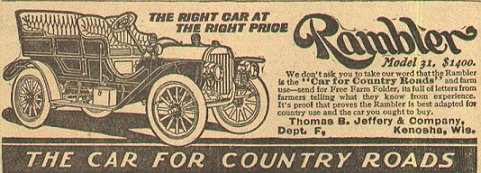
[Image of the 1908 Rambler advertisement linked from the Wikipedia commons. See also the article on the Rambler.]

The fifth and final installment in the "Rambler's Musings" series, published in the Chatham RECORD on Feburary 18, 1914, follows:
RAMBLER'S MUSINGS. No. 5.

Is it not aggravating for a man to sit down and build air castles and then have a puff of wind blow them into a thousand pieces? That's what Rambler did, or rather let his imagination take him a hundred years ahead to see the "new" Pittsboro. What he thought he saw was enough to make most any of the people here today wish they could live that long. But it is not to be and although one hundred years from today Pittsboro may have a population of 50,000 souls, may have factories, paved streets, trolley lines and everything up to date, not a living soul here today will be here then. Every single person -- man, woman, child -- will be dead and forgotten.

Then while we are living today why not let us make the best of it? Let us get some of the pleasures and advantages that the people a hundred years hence will be enjoying.

Other towns are growing, why not this one? People here want industries to come; they want people to move here; they want paved streets and they want good roads leading into town.

But strange as it may seem and bad as they wish for these things, some of them put a check to the growth of the town when a person proposes to buy land and bulk here. If you buy my land, they say, you must pay for it. I don't blame a man for trying to get all he can for his land. It is natural that he'd want to do so, but there are times and places where a little foresight could be used in reducing their property value. It would be. more beneficial to them In the long run, help reduce their taxes, fill up the vacant places and cause Pittsboro to start to grow. Some people never stop to think of old man Malaga Grapes. He owned land, had money, horses, everything, and he probably thought he'd take it with him -- BUT HE DID NOT.

Tell me why dirt in Pittsboro should be priced so high and I'll tell you why there is no money at the end of a rainbow.

If Pittsboro was filled with manufacturing plants; if it even had a population of 10,000; if it had electric lights, paved streets, water, sewerage and no hog pens, people might have some cause for raising the price of their property, and unless property owners place a fair value on their lots people will not come here, nor will any enterprises, which so many people crave, ever be started here, and the owners of these high-priced lot will go the way of their fathers. It is true it can be left to their children. Malaga Grapes did that very thing.

Rambler knows of a case where the owner of 300 acres of land is od and feeble. He cannot work. But before he'd sell that land for $4,000, which he has been ofered, and place the noney at interest he rents it for the magnificent sum of $90 and has to pay the taxes on it.

Why not cut up his big farm into fifty acre plots, if he does not care to sell, and rent them out. He could get at least $25 a year for each farm and there would be six ears of corn grown whre only one is grown now.

"Everybody to his own notion," said the groundhog, as he went into his hole to escape the snowstorm.

RAMBLER.

22 October 2007

Rambler #4 (1914)

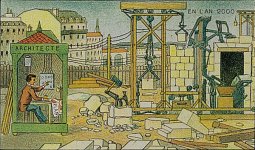
[The images L'avenue de l'Opéra and Chantier de construction électrique linked from Visions de l'an 2000, a 1910 series depicting life in the year 2000. From a digital exhibition of the National Library of France, hat-tip to the remarkable time-sink of a blog, Paleo-Future, "A look into the future that never was," and to tommy yum, who showed it to me.]

We continue here with #4 in the series of five numbered columns written for the Chatham RECORD by a pseudonymous "Rambler" in the opening months of 1914. In this installment [skip to it], published in the RECORD on January 28, 1914, Rambler imagines himself a Rip van Winkle falling into a hundred-years' sleep in the woods beyond Roberson Creek, then awaking to a vision of Pittsboro in the year 2014. It's an interesting bit of local speculative narrative, and probably the main reason why I chose to reprint the Rambler series.

Revisiting attempts from past eras to predict the future involves us in a kind of negotiation between things familiar and alien. There's a certain pleasure that arises when we see human needs that seem obvious and enduring get "solved" by innovations in obsolete technologies. So when the marvelous blog Paleo-Future shows us an advertisement for a wireless phone from 1910, we instinctively love it, in part because the functional need for a wireless telephone asserts itself as so obvious and eternal, and in part because the apparatus seems somehow to require an umbrella.

When Rambler talks of flying above a Pittsboro that spreads five miles south and north to the Haw River, well, he's not far off from what we're likely to see in 2014, even if he doesn't quite have the details right. His map grid of 991 numbered streets seems whimsical, but his overall vision of a boom has a ring of prescience to it. The projection of 50,000 people matches the entire county's population at the 2000 census, but seems on target for the northeastern quadrant of the county over the next decade or so. Bynum may not have a population of 3000 in the year 2014, but the Briar Chapel development resides in its township of Baldwin, and very well could. The train tracks no longer run through Pittsboro, and public transportation has no reach in town, but if we cup our ears and mute the TV we we might hear echoes in our bio-diesel boomlet of Rambler's invocation of cars (and tri- and unicycles) powered by electricity.

Part of the piece's appeal is Rambler's fixing his vision in the year 2014, which lies just ahead of us in our own future, imminent enough that our own planning cycles encompass it. This past weekend, news came via a political pamphlet left on my doorstep of "unprecedented development pressures making the Tues., Nov. 6 town election one of the most important in county history." The flier from Pittsboro Together has emblazoned in large, bold type across the front a word the Rambler could relate to: imagine. And yet, these smart-growthers do not bring visions of flying cars. They ask us to imagine, instead, "if Pittsboro became like Cary..." For readers beyond the Triangle area of North Carolina, "Cary" is a nearby Piedmont municipality said to be so overfed on sprawl that it stands as shorthand for the ultimate in suburban dystopia. On the one hand, who doesn't want a prosperous town? On the other hand, no one seems to want Cary.

I think Rambler would delight to see the Pittsboro of 2007 grown ripe with the fruits of technology and population growth: paved streets and a visible, uniformed police force to name two that he cites, and while they might seem humble in a place like Cary, I think he'd agree that our shiny new co-op, microbrewery and big box hardware store qualify as the "magnificent stores" he mentions; more of the same is surely on the way. But he would find the terms of the discussion to be very different than in 1914. It's easy to love the idea of a prosperous Pittsboro, but hard to see how prosperity lasts unless it's balanced with sustainable living and long-range planning. The industrial age is over; human- and rabbitkind produce more and we also consume more than in our youth. Somewhere we as a, um, people crossed a threshold into middle age, and the dreams of the Rambler lose some of their charm.

Still, I think it's fair for a Rabbit to ask: where's my flying car?

"Rambler's Musings No. 4" (January 28, 1914) follows; see below for more about the Rambler.
RAMBLER'S MUSINGS. No. 4.
Editor of The Record:

Rambler has talked of building dwelling houses, cotton mills and manufacturing plants. This week he is going to take you a hundred years ahead. In other words, in imgination, he is going to sleep and not wake up until the year 2014. If the reader will let his imagination run ahead for a hundred years he will be able to see Pittsboro in a new light.

* * * * * * *
Gracious! I feel tough. This has been the longest night I believe I ever saw. What am I doing over here in these woods? Have I been drunk and wandered away out here to keep anyone from seeing me? Gosh! There's a lot of fuss going on over in town. Listen at the steam whistles. Capt. Alson must be going. out. No, that’s not his train. There goes another whistle. And listen at the bells. I never heard the sound of bells like that before. Why, that sounds like a street car! What's the matter with me?

I got up on my feet and looked around. Where am I? What's the name, of this place? I never saw this town before. I am going to find, out where I am. Yonder is the railroad. Look at the tracks! I've been asleep here all night, but all those tracks were not there yesterday. I take up the railroad. Why, here's Robertson creek and this place must be Pittsboro. It is, I am told, but look at the new street, and the houses built up alongside the creek, and they extend as far as I can see. What's the matter with the place. It wasn't that way yesterday. I am drunk again, and lost. I'll nave to tell Mrs. Rambler another big ghost story.

I come to a street crossing. A sign on the corner reads "First street, East." I take up that street and go west about four blocks. Stores to the right; stores to the left. This cannot be Pittsboro. Yes, that is what it is, was the answer a blue-coated policeman gave me. Am I dreaming? No, I am wide awake. I look down at my feet; I move them; I am not asleep.

I finally reach one of the principal streets, I guess, as there were thousands of people walking the sidewalks. In the road way were all sorts of vehicles, all run by electricity. Some had two wheels, some three and some with only one wheel. Some of these vehicles were loaded with merchandise and some with people. Everything was moving. Hello! there comes a street car! Yonder is another one crossing the street. I stand bewildered -- lost. I knew I was in Pittsboro yesterday. There is the monument over there, but where is Manly Smith's wooden building? Look at the magnificent stores; and the streets are all paved. They have policemen in uniforms. Pete Gunter did not have a uniform yesterday. This can't be Pittsboro.

I wander up the street further. Hello! there's a printing office. I believe I'll go in. On a table lies a pile of papers. No one is in the room. I pick up a paper and look at it. It is the Chatham Record, dated January 25th, 2014! It was January 25th, 1914, when I wandered over to the woods beyond Robertson creek and laid down and went to sleep -- just 100 years ago today. And I thought it was yesterday.

Rip Van Winkle slept 20 years and I have slept 100!

While looking over the thirty-two pages of The Record a gentleman entered the room. He was a fat, chunky man and wore a cap -- it was Col. Bruce Poe. I recollected him in a minute. He recognized me too.

After talking over bygone days I asked the colonel how it was he had lived so long and was looking so healthy. "Why," he says, "you recollect away back yonder Capt. John Crump had a preparation -- a powder -- called "Life's Elixir?" You know it was said at the time it would prolong a man's life hundreds of years. Well, there was only three men in town outside myself that used that powder, and that was Col. Dr. Pilkington, Capt. Crump and Col. Fletcher Mann. The doctor," he continued, "is still in the drug business when he is on the ground. Col. Mann is in business at 592 West 742d street. He has been married five or six times and, you wouldn't believe it, but he is looking for another wife. Capt. Crump is working for the telephone company. He fell off a pole two or three days ago and broke a leg, but he put some of his powder on it and he is all right.now. I think he flew over to Raleigh this morning in his bird car."

Hundreds of other questions were asked the colonel about former citizens, but they were all dead.

Then he took us out to his bird house. He does not deal in Ford cars now but is a birdite. His bird, as he called it, was in the shape of an eagle; had the head, the tail, the appearance of a bird. I was asked to step inside. I was afraid, but I got in and sat down. I wish I could describe my feelings but have not got the space. He touched a spring, there was a flutter or two and the car sailed gracefully in the air. It was fine -- grand. We were about a mile in the air when we espied a car coming towards us. "Here comes Pilk now," he said. In a moment the two cars stopped alongsde [sic] of each other. We shook hands, talked a few minutes and separated.

The air was full of cars. Any way you'd look you'd see them.

Here I got good view of Pittsboro. From where the old courthouse used to stand (a magnificent one stood there now) the streets going north and south were avenues. The cross streets are numbered from First street to 991st and extend from Haw river on the east to Rocky river on the west. The avenues extend from five miles on the south to Bynum on the north. Bynum has a population of 3,000. On Haw river could be seen the big power plant.

And all this space was filled with residences, mills, factories and 50,000 busy people.

Thirty eight electric passenger trains alone stopped at the union station daily.

There are three daily papers printed in the city.

The town has grown some within the last hundred years, remarked the colonel, as we stepped upon the ground.

RAMBLER
When I opened the series, I had found no other columns by Rambler, but further research has turned up more of his writings. The numbered series of "Rambler's Musings" that began in January 1914 seems to have cut off at #5 in February, 1914; but Rambler wrote to the RECORD on numerous other occasions. The "Musings" series focuses on a vision for the development of Pittsboro, while Rambler's earlier columns tended to pass along local anecdotes, gossip, folklore and tall tales.

In "Musings" #4, Rambler goes off an extended tangent treating the "Life's Elixir" powder invented by a Capt. Crump of Pittsboro. As it happens, a piece appears in the Chatham RECORD of July 2, 1913, which relates a tall-tale or two about "Life's Elixir"; unfortunately, my current copy of the issue cuts the "Pittsboro Inventors" piece off and right now I can reprint it only in part, also below. I'll update this post with the full version at the earliest opportunity, but I'd have to say I'm about 99% certain it also came from the pen of the Rambler. It echoes his style, and also features prominently the figure of "Col. Bruce Poe".
Pittsboro Inventors.

While Pittsboro as a town cannot claim as many noted things as some other towns in this State, it has nevertheless some smart inventors. Among them is Capt. J. J. Crump, the inventor of the cross-cut saw, the hobby horse the see-saw and other useful things.

The captain once invented a horse-shoe that was put on without nails, but it did not prove much of a success, as the glue would get damp and the shoe drop off.

His latest realization of a success was a powder, which is composed of several ingredients. This powder he calls "Life’s Elixir," and is good for man or beast. To prove its efficacy as a milk producer and cow fattener, I will state the following facts:

Col. Bruce Poe, one of the finest gardeners in this State, the man who raised Irish potatoes so large and they grew so fast that they pushed his fence several inches from the line, bought a cow from Col. Bob Glenn. It was a small cow, but Col. Glenn said he'd guarantee that the cow would give a quart of milk a day. Col. Poe knowing the wonderful effects of Capt. Cramp's powder, bought five cents worth of it. Before giving the cow any powder he milked her for the first time that evening and she gave her usual amount, a pint. After milking he gave her more feed and a tablespoonful of the powder. The next morning the colonel went out to milk his cow (the colonel is a fine milker and delights in the pastime). He noticed that the cow had grown considerably larger, but he begin to milk and sing (he always would sing while at work) and the milk began to flow, slowly at first, but faster. Soon his pails were full and he called for more vessels. In a few minutes they were full and more buckets were culled for. The colonel had quit singing; consternation was depicted on his face. "Bring me some tubs," he called out in alarm, "this cow is raining milk." The tubs were soon full; in fact, everything that would hold milk was full, and still the end was not in sight. "Go and tell Capt. Minor to come here," said the colonel, excitedly. "What do you want with him," he was asked. "I want to rent the water tank over at the oil mill." Just then the sluice of milk began to cease -- the cow had been milked dry.

On feeding the cow that night (she was not milked any more that day) she was given another tablespoonful of the powder, and that was the colonel’s undoing. During the night the cow had grown so fast that she had pushed down the fence and next morning was gone. The colonel has never seen her since.

[Cont'd]

21 October 2007

High Strangeness: Watch the Skies!


[UFO image from crowdedskies.com.]

More Blood Fall goodness on the way, I assure you. But let's contemplate what else exists in Chatham's skies. I'm delighted to let reader Martha share her story with you, as it was emailed to me:

My sister and I were driving back from Chapel Hill late at night after seeing a movie I think. I want to say it was Good Morning Vietnam. It wasn't horribly late, but late enough, and in those days far fewer people lived out Jones Ferry Rd. in Chatham County so there was very little traffic. Just after we crossed over University Lake and were heading out of town, we noticed a very bright white light in the distance hovering at tree level. We talked about what it could be and speculated about it being the new WUNC TV tower that had gone up across from Story Book Farm. At the time, the large white tower was rather new and it was an eyesore because it blinked so brightly. However, the bright light on this evening was not blinking. As we drove, the light stayed stationary in the distance. We passed Story Book Farm and the blinking tower and the bright light was still ahead of us. Of course, now we were really wondering what was up. A helicopter with a search light on it. maybe? That was the best we could come up with, but given that is didn't move at all it seemed somewhat unlikely. When we came to Frosty's we pulled into the empty parking. The store was closed for the night. We stopped the car and turned the car off. The object with the bright white light shining down was right above the intersection of Crawford Dairy Rd. and Jones Fairy Rd. We rolled down the windows and it was completely silent. So silent you could hear the crickets and cicadas making their summer racket. Definitely not a helicopter. As we both sat there and looked at this thing (I recall it as being rather triangular-shaped like something from Star Wars, but my sister recalls it being saucer shaped), I'm not even sure we said anything to each other. We just stared. And then quickly, the light went off, the engines of the ship powered up (but weren't horribly loud when they did), and it took off really fast into the sky. It all lasted probably less than a minute or so.

So that's it. Never seen a UFO since. And have never figured out why one would be hanging out where this one was. Talk about boring. Maybe it was looking for the Big Hole over off of 54 and was checking the map.
She added this, in response to my queries:

The engines I guess sounded like jet engines gearing up, but not nearly as loud or deafening as that. And it took off very fast. The "ship" itself was not that large. Larger than a trash can though. Maybe the size of a reasonably sized room in a house. 50 X 50 ft? 30 X 30? Not small, but not huge by any means.


What are we to make of this? I don't know. The trash can reference is to a story I related to Martha, in which some friends of mine were chased by a trash-can shaped object as they drove their van to the beach. The object rose up from under an overpass and pursued them at speed for some miles before disengaging.

20 October 2007

Rambler #3 (1914)

[Image of auto stuck in the mud from the National Museum of American History's "America on the Move" exhibit.]

The Rambler series continues with #3, from the Chatham RECORD of January 21, 1914:
RAMBLER'S MUSINGS.
No. 3.

Editor of The Record:

Last week we talked on a cotton mill and house-building. We are going to talk about something this week that Rambler hopes will interest you.

Did you ever see a horse and wagon stalled in the mud? No matter how hard the horse pulled he could not move the wagon. All sorts of advice would be given the driver only to fail moving the load. The horse just could not budge it until a lot of husky fellows gathered around the wagon and put their shoulders to the wheel.

It moved then, didn’t it? You bet. So it is with some towns. A town will get into a rut. A few spasmodic efforts will be made to get it out by some of the more enterprising citizens, then a few more little jerks and pulls until it finally looks as if the poor old town was gone for sure.

But some day another kind of a fellow comes along and he sees the old town, and he also sees how bad she is stuck in the rut. He likes the looks of the place. it seems good to him. The people are clever, sociable and entertaining and he asks himself: "Why is this thus? Why don’t these people get on the main line?" And the more he studies over the question the more it puzzles him. He pulls off his coat and goes to work. He talks to this business man and that. He talks to the citizen. He tells them the advantages of such and such a thing; how it would benefit them, and not only them but others. The eyes of these people are opened. They, too, get to work and the result is the old town is MADE to get out of the rut. New life is taken on, new people move in, new enterprises come in, business gets on a boom, new stores and new residences begin to spring up, everything begins to flourish and everybody carries a happy face.

This is not an overdrawn picture. The town of Pittsboro has been in a rut for many years. Time and time and time again have some of its citizens tried to get it out, but the more they pulled the deeper it seemed to sink, until they gave up in disgust and despair.

Now there is yet a chance to get the old town back on its feet again, but every man must put his shoulder to the wheel and PUSH. IF YOU CANNOT PUSH, PULL. If you cannot do either don’t get in the way. LET'S ORGANIZE A CHAMBER OF COMMERCE. That will be the husky fellow to pull us out of the rut. Let the citizens get together and talk the matter over. "Argufy" the matter, as it were. There are plenty of public-spirited citizens here, and there may be some in the county who have not lost all pride for their county capital, that would join. Who knows but what such a movement, if conducted on the right line, would not be a stepping stone for the people of today to leave to future generations. Let's try it anyhow.

RAMBLER.

16 October 2007

Rambler #2 (1914)


Continuing the Rambler series, #2, from the Chatham RECORD of January 14, 1914, follows:
RAMBLER GETS TO MUSING.
No. 2


Editor of The Record:

The story printed in last week’s Record about old man Malaga Grapes is no joke and has a moral. It shows that man, no matter how rich he may be of this world's goods, when he dies he is brought down to a level with the poorest on earth.

Then why should a man toil and struggle, hoard and save for others? Would it not be better for him, for his family, for his county and for the people in general if he had taken only a part of his savings and put it into some manufacturing plant, where it would not only have helped him but also helped many others. You have got to die. There is no getting around that point, and it is a fact beyond question, that you cannot take your money with you. Then let Rambler offer some suggestions.

We are not talking particularly to the people of Pittsboro but to the whole county. It is the duty of every citizen in his county to take some pride in his capital city. Pittsboro has stood here for lo these many years. It seems to have got stuck here, and it needs the help of the business man, the farmer and all others who have any pride at all for their county seat to come to its rescue and pull it out of its present condition.

There are vacant lots galore here that need the hand of man to better improve them. Pittsboro needs houses. Here is the place where thousands of dollars could be invested that would pay the investors at least from 6 to 10 per cent and probably more. There are half a dozen families here today that would be glad of the chance to rent four or five room houses, but they are not here. People would come here to live if they could get houses, but they cannot get them and they move to other towns. Then again, how can you expect manufacutring plants to come into a town when the people do not seem to care whether there are any houses or not.

Every little business helps. Look at the hosiery mill here. Though small, yet several thousand dollars a year is spent among the merchants and others. Look how many thousands of dollars have been paid out by the Chatham oil company, by the Nooe planing mills and other works.

Pittsboro has a splendid school, excellent teachers and the healthfulness of the town cannot be surpassed. It could be made a fine winter resort if it was pushed in that direction. Don't say "Shucks! Pittsboro will never be more than it is. It's dead already." No wonder, when some of its own citizens continue to knock it in such a manner.

Pittsboro is not dead by any means, notwithstanding its hard knocks and kicks. Let the enterprising business men of the county and town put their heads together and invest their surplus in a cotton mill, or a wagon factory, or a chair factory or some other kind of a plant. LET 1914 BE AN EYE-OPENER to the Jonahs.

Have some pride in your county capital. One hundred men in Chathazn could easily raise $100,000 for a cotton mill, and Pittsboro is the logical place for it. There are the railroad facilities here, and sooner or later another railroad will be built through here, and there are two of the best sites here for a cotton factory that can be found in the state.

The monied men of this county might think seriously of this project to their own advantage as well as to the community.

Remember, six feet of earth is all you will have when you are dead, and you will be dead along time. Then leave something behind you to benefit humanity.

The clock has struck 1914, men. Let's get to work.

RAMBLER.

Rambler #1 (1914)

This blog is a prequel. The idea of the Chatham Rabbit hatched as a way to connect the backstory of Chatham County, North Carolina to its doozy of an emerging narrative. In the current story, a fable for our troubled times, a sleepy little backwater county wakes up at the turn of the 20th Century to find an array of powerful and not-so-powerful interests contending for its soul. As the place's landscape, populace and social life transform under intense growth pressure, its core story follows, like it or not (and some do and some don't) the expanding course of residential development. The blog does a small mammal's mite to save some fragments of memory before that flood.

Now, when one takes on such a project, and heads to the library and into the field to do some research, all kinds of stuff can turn up worth writing about. In this space we've shared nuggets harvested from a range of sources, particularly the county's long-running newspaper, the Chatham RECORD (est. 1877). The Rabbit has relayed stories of love and marriage, community life, and the lore of the rabbit. Fellow traveler tommy yum has written of High Strangeness. We cast a wide net here, it's all wholly within scope, and we think it's all worth knowing, for while this document is about land and its use, it's also about place. Furthermore, rabbits love stories, plain and simple, and find it impossible to resist their trails arrayed like so many cabbage rows across the gardens.

But with all the dallying in the ways of lovers and horse-traders and blockaders, it's well-nigh time to take up in earnest the story we originally set out to tell, the one where the land acts as a character. Debates over land use are nothing new to this space that has been a county for 226 years, and so the Rabbit will feature some of those discussions as they appeared in the Chatham RECORD and elsewhere a century or so ago. I'll begin with the series of pseudonymous columns penned by a self-styled "Rambler" in the RECORD beginning in January of 1914.

I'm not sure who the Rambler was, and if any readers can provide information regarding the person's identity, please contact me at precept6@yahoo.com. So far in my research Rambler's trail goes cold after five columns, but those five provide a departure point for an analysis of views of land use in the early modern age. They also keenly express a vision for Pittsboro that some will find interesting to read.

I'll reprint all five of the Rambler's columns over the next week or so. In the first column, the author lays out what we might call a moral basis for development. It's something we all do, and as Exhibit A I offer the Rambler, whose own moral the reader will discern from the first of the series, from January 7, 1914.
RAMBLER GETS TO MUSING.
No. 1.

Editor of The Record

Old man Malaga Grapes is dead. Malaga is not his correct name. Neither is grapes, but it answers all purposes. But Malaga is dead and buried. Over in the cemetery where MaLaga's body is lying there are several othet bodies nearby. Over on the left is a grave that contains a pauper. The pauper is dead, too, else they would not have buried him. Over to the right is the grave of a woman. This female was a great talker. She talked about her neighbors until they shunned her; she talked about her church members until she was turned out of church. When she had nothing else to talk about she talked about the cat. This woman was a tale-bearer, the worst of all women. So one day she died because her breath gave out and she could not work up enough wind to start her to talking again. So she was buried quite near Malaga Grapes' grave.

In another grave a thief lay. Other graves around Malaga's grave contained different kinds of people -- some good, some bad, others worse. Malaga did not care because he was dead too.

Malaga had worked hard all his life; had saved his money, stinted himself, eat half enough, and the coat he wore to town was the coat he wore year-before-last and-year-before-that-year's-coat; it would do for him, he said, for next year and year after. It was too good to throw away. And he kept on wearing that coat every day and Sunday too.

Malaga had money. He was worth half a million dollars. He had land, stock -- everything to make a sensible man happy. With all his money, with all his land, with all his stock -- he was dead and buried -- surrounded by a thief, a pauper and tale-bearing woman.

Malaga had nothing now. Neither did those other three. All were equal.

Malaga's wife died years ago, probably from starvation or a broken heart, but he kept on working and hoarding and saving until he reached the half a million goal. Then he died.

What became of all of Malaga's money, cattle and land? His only son fell heir to it and today he is living a profligate's life; smoking high priced cigars, drinking $5 bottles of champagne and wearing fine clothes.

What a different tale could have been told if old Malaga Grapes had taken $100,000 of that money, come to Pitssboro and put it into a cotton mill. He would have given work to hundreds of people; he would have helped to build up the town; he would have been looked upon as a good man. The worker would have spent his money with the merchant; the merchant would have improved his store and stock; the churches, the town and the county generally would have been benefited.

But, no. Malaga Grapes, like many other men with money and lands, did not see it in that light and hoarded his money and starved himself so others might reap the benefit.

You can save and pile up your riches but old Father Time will get you in the end and, so far as your money is concerned, the old shacks you leave will remain old shacks; the idle land will continue idle, and you are dead, having passed through this world not benefitting yourself or mankind.

If you have money put it into something that will help humanity. Take lessons from the Cones; take lessons from other philanthropic men and do likewise.

Remember only six feet of earth belongs to you and you can not take your money with you.

RAMBLER.

09 October 2007

Return of Love Rabbit (1892, 1909, 1890-1914)

1) A few weeks ago we noted the sweet story of James W. Pearce and Maggie Pearce, who found one another via an advertisement in the Raleigh NEWS AND OBSERVER, courted by mail, met up and got hitched in Greenville, NC. Sadly, the Rabbit did not have the whole story when the item went to press. A follow-up item appeared in the "Local Records" soon after, on November 10, 1909:
A few weeks ago The Record published the romantic marriage of Mr. J.W. Pearce, of Albright township, to a widow in Pitt county, the result of an advertisement in the News and Observer. We regret to learn that the romance is shattered and so are the hopes of wedded bliss, for the bride has left her groom and returned to her former home.
2) The following surely invites further exploration, but it's worth teasing now. "Love Rabbit" goes major-daily in the New York TIMES of December 4, 1892:
TRICKED HER AGED LOVER.

THE SHREWD GAME OF A NORTH CAROLINA GIRL SPOILED

RALEIGH, N.C Dec. 3. -- In Chatham County live Samson Edwards and Jennie Culberson. Samson is hale, hearty, and sixty-two years old, and handsome for a man of that many years. Jennie is twenty-five years old and is a remarably pretty girl.

As the world goes, the old man wanted a "darling," and the girl wanted a slave. They courted. Jennie, being without worldly goods, told Samson that if he would give her $275 she would marry him, and with the money she would buy a tract of land and take the deed in her name, and that this would suffice in place of dower in case she survived her aged lover. Samson gave her the money. She bought the land, and the deed was made to Jennie Culberson.

Old Madam Eve then appeared. It seems that a younger man had been going to see Jennie on the sly. The day for the wedding with Edwards was set. The preacher was engaged and the license procured. On the day before that set for the wedding Jennie end her younger lover journeyed to Pittsborough, the county seat, and there they were married. They returned and took up their abode on the land paid for with the money of Edwards.

The frame of mind of Samson when he heard of the marriage is better imagined than described in cold type. He sought his lawyer and brought suit to recover the land. The case was a noted one and the whole county was present In Pittsborough when It was tried. The Superior Court gave judgment against Jennie for the money, but refused to order the sale of the land to pay the debt and Jennle had no other property.

Edwards then appealed to the Supreme Court, and this tribunal has just decided tbat Jennie perpetrated a fraud on Samnson and violated her contract of marriage; that the transfer of the land to her was without consideration, and that the land must be sold to pay the debt of Edwards.
3) Finally, the Rabbit can but blush at the goings-on! Chatham RECORD, 1910 MAR 2:
A Real Romance

At February term, 1890, of the superior court of this county Dr. John Sanford Stone and Vallie Weathers, both of Cape Fear township, were convicted of fornication and adultery and he was sentenced to imprisonment in our county jail, but after serving a few months he was pardoned because of his bad health. Judgment was suspended on the woman. Sometime after this they both left this county, he deserting his wife and family, who heard nothing more of him until last month, when they heard that he had died recently in Georgia.

One of his sons went last month to Georgia, in consequence of information received, and there found that he and Vallie Weathers had been living for several years as Dr. and Mrs. John Sanford. At the death of Dr. Stone (or Sanford as he was there called) the woman, who was thought to be his wife, was allotted the usual year's allowance as his widow. His property in Georgia was estimated to be worth $1500, and now his family, whom he deserted, will take the proper legal steps to secure possession of it. His deserted wife is still iving, a most estimable lady, and her friends are glad to know that she will at last get something from his estate.

Our society has been going downhill, ever since 1800.

02 October 2007

High Strangeness: Blood Fall (1884)

[Photograph of Francis P. Venable from the UNC Virtual Museum of University History.]

On a clear day in 1884, it rained blood on a farm in Chatham County.

"Pooh!" scoffs the Gentle Reader. "Nothing weird ever happens around here, except the '70s." Ah, but I can prove it.

The event had an eyewitness. There were other, more gentrified witnesses of the immediate aftermath. And none other than UNC chemist Francis Preston Venable (pictured) published an article, "'Fall of Blood' in Chatham County" in the Journal of the Elisha Mitchell Scientific Society.

The March 6, 1884 issue of The Chatham Record took a dubious tone in its article "A Shower of Blood:"
We do not ask our readers to believe the following wonderful statement, but merely publish it as it is told us. The wife of Kit Lasater, a negro who lives on the farm of Mr. Silas Beckwith in New Hope township, states that, about 2 o'clock on Monday the 25th of February, while she was at the bars near her cabin a shower of blood fell around her from a sun-bright sky!
We are pleased to note that The Record elected not to include any gratuitous details of "negro" eye-rolling and hair-straightening. They couldn't resist, however, this zinger at the end:
We are informed that a reputable physician of the neighborhood visited the spot and said it was blood.
It's not inconceivable that a tenant farmer, no doubt proficient at slaughtering hogs and chickens, would easily be able to recognize blood. Nevertheless, every neighborhood should have a "reputable physician."

More white men came to behold the wonder. SA Holleman visited the next morning, later describing the scene to Venable:
The space covered was about fifty by seventy feet, and nearly in a rectangular form. The drops were of sizes varying from that of a small pea to that of a man's finger and averaged about one to the square foot...Some fell in the bushes and coagulated upon the limbs.
The "reputable physician" must have been a certain Dr Robinson, who, according to Venable, "made certain simple tests which satisfied him that it was blood." Venable's next sentence is more explicit: the sample passed the Robinson Sniff Test.

Samples of bloody sand got into the hands of Holleman and another doctor, Sidney Atwater. Atwater brought the samples to the University of North Carolina at Chapel Hill for analysis.

"It was looked upon rather as a joke and no analysis was made for some time," Venable noted.

But when preliminary tests were conducted, something happened that must have made Venable's prodigious mustache curl up with a hilarious "tweeter" sound:

The blood was real.

To be continued.

Do you have stories of UFOs, ghosts or other weirdness that you'd like to see covered in the High Strangeness corner of the Chatham Rabbit? Email me: pborowest@yahoo.com

01 October 2007

Vaudeville comes to Pittsboro (1909-1910)

[Images cropped from the digitized materials in the University of Iowa's digital collection, "Traveling Culture: Circuit Chautauqua in the Twentieth Century".]

In October of 1909 the Chatham RECORD publicized the first of three entertainment events intended to raise money for Pittsboro High School. A few weeks later, a review of this initial performance referred to these events part of the "Lyceum course". The Lyceum Movement, a concept of adult education that began before the Civil War, emphasized community culture in the setting of town hall gatherings. It was on the Lyceum circuit that luminaries like Ralph Waldo Emerson, Mark Twain and William Jennings Bryan spoke before eager crowds whose attention spans would surely astonish us in our own time. Many lesser lights worked the circuit as well, and "permanent lyceums" established themselves around the country.

Following the war, the Lyceum retained some of its high-minded characteristics while edging more into an entertainment circuit and a venue for vaudeville acts. Eventually the Chautauqua movement took the original Lyceum concept of adult education and community culture and ran with it, while vaudeville became the source from which an emerging entertainment industry drew such acts as the Marx Brothers and W.C. Fields. The performers that visited Pittsboro in November of 1909 and then January of 1910 certainly shaded into the territory of vaudeville. Thanks to a library digitization project at the University of Iowa, we can take a look at the printed programs that likely accompanied these performers and provided advance publicity. In this post I'll link the three acts to Iowa's "Traveling Culture." More broadly I'll embark on an ongoing effort to describe the intellectual and cultural lives of the people living in the county and its surrounds about a hundred years ago.

The Pittsboro High School benefit series began with a magician named Hal Merton. The October 27, 1909 issue of the RECORD advertised his performance in terms so glowing and detailed that the author (surely the paper's editor, Henry A. London) seems to have experienced the maestro's act in person:
The Magician Merton.

On Thursday night of next week, November 4th., this community will have the opportunity of enjoying the most unique entertainment ever had here, when Hal Merton, the wonderful magician, will give one of his mysterious performances, the same that he has given in the large cities of this county.

Disdaining the aid of apparatus of any sort, Merton appears on the stage with his arms bared, and, depending entirely upon personal dexterity, accomplishes a series of remarkable feats, baffling the eye and the understanding alike. Eggs, billiard balls and flowers appear suddenly at his finger tips, vanish as mysteriously as they come, and then reappear at command. He will cause objects to spring from nowhere back to nowhere and will make hats and other objects perform remarkable antics. For comedy and mystery this entertainment will surpass anything ever seen here, and every body ought to attend it.
But London almost certainly had never seen Merton perform before. The circular for Merton at the "Traveling Culture" series must have preceded the magician Merton to the office of the RECORD. Compare the wording of London's description to the text in the program's inner pages [emphasis mine]:
Upon a brilliantly lighted platform, with arms bared to the elbows, Mr. Merton will demonstrate to the satisfaction of all that it is not only possible for an article to be in two places at the same time, but that it is equally possible that it may be nowhere at all. Solid articles, eggs, billiard balls, flowers and handkerchiefs appear at his finger tips and having served to amuse, vanish as mysteriously as they came, reappearing at command in the most unexpected places; a borrowed hat plays a most important part in the evolutions of a tumbler, ladies' rings develop most astonishing powers, a gentleman's watch figures in a series of startling surprises, silver bands become endowed with more than life and many of the most puzzling demonstrations of the Hindoo necromancers are duplicated for the first time upon the Lyceum platform. The Bouquet of Mystical Novelties concludes with a series of laughable feats in the pleasing and ever popular art of ventriloquism in which the famous blockhead "Joe" takes a most important part.
The RECORD hawked the event again in the November 3 issue, then provided a review of sorts on November 10:
No audience at this place ever before enjoyed more greatly any entertainment than did the audience at the school auditorium last Thursday night when Hal Merton, the magician, performed his wonderful feats of sleight-of-hand. They were truly wonderful and unaccountable and kept the spectators most delightfully entertained. The next entertainment of the Lyceum course will be on the night of the 29th of this month, when the celebrated Litchfield Trio will be here.
The RECORD then publicized the next act, the Litchfield Trio, in the November 24 issue:
Litchfield Trio.

On next Monday night at the school auditorium the citizens of this community will have the opportunity of enjoying one of the most delightful entertainments ever held here. The celebrated Litchfield Trio will then give one of their attractive entertainments, and it is of a different kind from any ever before seen here. It consists of humorous recitations, character impersonations in costumes, music of various sorts and a comedy entitled "Down at Brook Farm", which of itself is well worth the admission price.

The Litchfields are a man, his wife and daughter, all first-class performers, who will keep their audience highly amused and entertained with their character impersonations, humorous songs and splendid music. Wherever they have appeared they have given entire satisfaction, and a rare treat is in store for all who will be present next Monday night. No one who attends will regret it, and those who do not attend will regret missing so rich a treat.
The image shown here, a detail from the circular for the Neil Litchfield Trio, shows an apparent array of the "character impersonations in costumes" that Mr. Litchfield would perform. By the time the Litchfields visited Pittsboro, they had spent some two decades on the road to refine their act and test new portrayals. A search in a couple of historical newspaper databases provides a sense of their career arc and the itinerant lives they led.

The first mention makes no allusion to entertainment, only a notice under HOTEL ARRIVALS of a "Neil Litchfield and wife" in the Idaho Daily Statesman, April 1890. An August 1895 theater listing in the Duluth News-Tribune mentions Neil Litchfield as a member of a vaudeville company called "Heywood's Celebrities," then a notice in August 1897 places "Neil Litchfield, Yankee comedian" in a troupe performing the "WORLD FAMOUS CHARACTERS." At last Mr. and Mrs. Litchfield are listed together in the Washington Post theater notices of February 11, 1900 as part of a vaudeville review where they will "show a 'truly rural comedy' called 'Down on the Farm,'" which "has much snap and wit." From this point over the next several years the Litchfields appear regularly in the advertisements and notices of the Washington Post, New York Times and Philadelphia Inquirer, performing their signature "Brook Farm" skit. February 1904 they pop up in Kansas City, listed last in a long vaudeville bill at the Orpheum, where they are to perform "Halloween at Brook Farm." Just a few months before they came to Pittsboro, in August 1909, an advertisement in the San Jose Mercury News shows them performing "Down at Brook Farm" as part of a bill at Theater Jose, under the headline act, Doblano's Trained Sheep. The Lexington (KY) Herald has the Litchfield Trio playing there in February 1910, just a few months after their appearance here, then again in November of 1911. Finally, the Idaho Daily Statesman lists them in the "Immanuel Brotherhood Lyceum Course" in October of 1912.

Where the Litchfields appear in the larger city listings -- and at least some of the listings in the Post and Inquirer may be for venues in New York City -- they lie at or near the bottom of a larger vaudeville bill. The farther they roam from the major urban centers, the more prominent the mention they rate. In some cases, they even get reviewed, as in the 1910 appearance in Lexington, Kentucky, when the Herald wrote:
Enjoyable Entertainment

Despite the inclement weather, a large audience was present at the opera house to enjoy the splendid entertainment given by the "Litchfield Trio," who appeared under the auspices of the Midway Lecture Course. Refined and entertaining, the program rendered by this unusually talented family was thoroughly enjoyed by all present. No entertainment held here in years has given more universal satisfaction.
The RECORD's summation of the Litchfields' performance in Pittsboro practically echoes the sentiment they inspired in Lexington; from "Local Records", December 1:
No entertainment ever held at this place created more laughter and fun than that given by the Litchfield Trio on last Monday night. The impersonations and facial expressions of Mr. Litchfield could not be excelled and convulsed his audience with continual laughter. The music by Mrs. Litchfield and daughter was very fine and much enjoyed.
Finally, on January 26 the RECORD publicized the third of the three acts in the Lyceum course to visit:
The Italian Boys.

On next Saturday night will be the last and best of the three entertainments contracted to the be given here by the Radcliffe Entertainment Bureau. It will be given by Elbert Foland and five Italian boys, and wherever they have appeared they have been most highly complimented. No such entertainment as this has ever before been given in this town, and it is an opportunity that nobody should allow to pass by without attending it.

Mr. Foland is one of the most brilliant and versatile entertainers in the United States. He will both amuse with his humorous recitations and facial impersonations, and also entertains with his wonderful elocutionary talents. The music by the Italian boys charms and delights every audience that hears them, and no such music as their has ever been heard here. Their musical nad literary fantasy "A night in Venice" is of itself well worth the price of admission to the whole entertainment, even if there was nothing else.

Each of the two preceding entertainments given by the Radcliffe Bureau gave perfect satisfaction and this one is the best of all, as will be admitted by everybody who attends it. If you fail to attend this you will certainly regret it.


Again, the circular from the University of Iowa, and the mini-review by the RECORD on February 2:
The entertainment given here last Saturday night by the Italian Boys was greatly enjoyed by a large and appreciate audience. Their music, especially that on the harp, was the best ever heard here, and the singing by the boy of thirteen was flue-like and was twice encored. Mr. Foland's recitations and impersonations were much enjoyed.
Both the Italian Boys and Merton the Magician appear in similar patterns of listings as the Litchfields. All three of these acts were road-tested and probably quite compelling as performers, but they were all marginal vaudeville attractions, never top-of-the-bill in the big city. Of the three acts, the Italian Boys probably garnered the most swooning praise as they traveled, which suggests a certain timelessness to the formula of a boy-band with a soprano lead singer.

So far in my research, the RECORD does not follow up on these items with any mention of how the program fared in terms of raising money for the high school. As always, the Rabbit remains vigilant for more information, but unless the RECORD says anything else, it's hard to imagine where it might turn up.
Still, at some point, someone must have calculated that the acts would draw large enough crowds to pay the performers and provide a surplus for the benefit of the high school.

By the same token, some incentive must have drawn the performers to the road and away from the creature comforts of the big cities. Perhaps they earned more while traveling, maybe they enjoyed it, found creative stimulation, or used it as an opportunity to build an audience and a following. Maybe they just took pleasure in making the world smaller for rural audiences. Merton the Magician, the Litchfields, and the Italian Boys all brought to the high school in Pittsboro a cultural experience that Chatham's farmers and merchants and their families shared with audiences in Lexington, and Duluth, and even San Jose. In a place that could seem as remote and occasionally forbidding as Chatham County, a polished boy-band with a soprano lead singer was just the thing to deliver the world.

29 September 2007

Rabbit Lore #14 (1909)

Chatham RECORD, 1909 SEP 15, "Rabbits at the North Pole":
From the Asheville Gazette-News.

Tar Heels will recognize a lamentable weakness in Dr. Cook's story. He says the last signs of life he saw was a bunch of rabbits, as they disported themselves about a glacier. As all North Carolinians in general, and the good people of Chatham county in particular, will at once realize, this is a most extraordinary rabbit tale. Your well regulated rabbit is a vegetarian, and as there are no turnips and parsnips in the region of the pole, no rabbit would think for a moment of abiding there. This is a part of Dr. Cook's story that may only be explained upon the theory that they have a carniverous [sic] breed of rabbits up that way, such as the Washington Post is most familiar with.

Rabbit Lore #13 (1910)

Chatham RECORD, 1910 FEB 23, "Chatham Rabbits":
From the News and Observer.

Rabbit is the principal diet of Chatham's connoissuers and epicures. No rabbits are shipped from Pittsboro because the fastidious people of that county seat get their beauty and many other good qualities from a diet of rabbits. The best cooks have ninety-seven different ways of cooking the rabbit, and the animal is so good in each way that when Pittsboro folks go away from home they carry enough rabbits to give them at least one a day while they are gone. They have been known also to carry a broiler and to be found by their hosts broiling a rabbit in their room after they thought everybody else had retired. They do not understand how anybody can prefer canvas-back ducks or Lynnhaven bays to the succulent Chatham rabbit.

Rabbit Lore #12 (1882)

Washington POST, 1882 OCT 18, "Protection in North Carolina" (from ProQuest Historical Newspapers):
John Gubbins in the Raleigh News.

The season is approaching when hares and 'possums will be plentiful, and when large quantities of this species of game will come pouring into Raleigh by the Chatham wagons. Now, I have a splendid 'possum dog, and brother Jim, he has a good dog for rabbits, and his boys are cute, too, in setting rabbit gums. But it is a well-known fact that Wake county rabbits and 'possums are much shyer and harder to catch than Chatham rabbits and 'possums, and besides, they are scarcer here than they are in Chatham.

Now, Mr. Editor, I think these facts will justify me and brother Jim in asking the county commissioners to levy a tariff on Chatham rabbits and 'possums to enable our dogs and Jim's boys' rabbit gums to complete with these foreign rabbits and 'possums, which I think would produce some revenue to the county, if it did not amount to prohibition. At any rate, it would enable us to declare a larger dividend on the products of our dog and rabbit gums. It is true it would raise the price of rabbits and 'possums to the consumers of those delicacies to, perhaps, double what they now have to pay, but it is necessary that individuals must suffer for the general good. Indeed, brother Jim thinks the higher the tariff the commissioners should lay on Chatham 'possums and rabbits the cheaper they would be in the Raleigh market. I don't know how that is but if the argument will hold water, pleaes use it in inducing the county commissioners to grant us the relief asked for.

25 September 2007

The Irrepressible Levi Poe (1906 - 1910)

As told by the Chatham RECORD...

1906, OCT 25, "Notice":
Notice

I will be in Pittsboro on Thursday, November 1, 1906. All that I hold papers against will be there to settle with me, as I shall be there only one day. After that day the papers will in 'Squire Burns' hands for collection. Please don't ask for any more time.

I have 80 young mules that I want to put out on twelve months' time, good papers, better than I have brought to the county.

B.B. Wagner.

1906 NOV 22, "$25 Reward":
$25 Reward

I will pay $25 for the arrest and delivery to the sheriff of Chatham county of Levi Poe.

He is a tall white man, about 26 or 27 years old, spare built, no beard, light colored hair.

B.B. Wagner,
Pittsboro, N.C.
November 22nd, 1906

1907 MAY 2, "Local Records":
Sheriff J.R. Milliken received a telegram from Norfolk Tuesday stating that Levi Poe, a young white man of this county who is wanted here for disposing of mortgaged property, had been arrested and would be held until sent for.

1907 MAY 9, "Superior Court":
The May term of Chatham superior court began on last Monday. The judge is Hon. Robert B. Peebles, who arrived on the train after 1 o'clock on Monday and opened court as soon as he had dinner.

[...]

State against Levi Poe was a novel case, the first of its kind we have ever known in this county. He had been indicted for disposing of mortgaged property, and when the case was called for trial his attorneys insisted that he was insane and could not plead to the indictment. The following issue was then submitted to the jury: "Has the defendant sufficient mental capacity to understand his defense?" After hearing the evidence the Solicitor said he would not resist a verdict for the defendant, and the issue was answered "no," and the defendant was ordered to be sent ot the hospital for the dangerous Insane for treatment.

1907 MAY 16, "Commissioners' Meeting":
The county commissioners held their regular monthly meeting last week and audited the following accounts:

[...]

Chas. B. Wright, for conveying Levi Poe from Norfolk to Pittsboro .... 40 45 [$40.45]

1907 MAY 23, "Local Records":
Mr. Levi Poe has escaped from the hospital for the dangerous insane at Raleigh, whither he was carried at the last term of our court.

1907 SEP 26, "Local Records":
At last May term of our superior court Levi Poe, of Hickory Mountain township, was sent to the department for the criminal insane at Raleigh, from which he escaped shortly thereafter and returned home. He had been having all right until a few days ago when he again became violent and dangerous, and made desperate resistance when deputy sheriff James T. [illegible] and a posse went to arrest him. He not only tried to kill them but also tried to kill himself before they could secure him.

1907 NOV 7, "Local Records":
Levi Poe, a young white man who was put in jail here about six weeks ago to await trial on the charge of disposing of mortgaged property, escaped from jail here last Tuesday night by breaking the lock to his cell with a cold chisel which he had secured in some way and forcing an entrance throught the ceiling of the building.

1907 NOV 21, "Local Records":
Levi Poe, who escaped from our county jail two weeks ago, was captured last Saturday at Raleigh and was returned to the insane department at the penitentiary, from which he escaped several months ago.

1907 DEC 19, "Local Records":
The irrepressible Levi Poe has again escaped from custody, being the third time in less than six months. Last May he was sent to the criminal insane department of the penitentiary, from which he soon escaped. In October he was arrested in this county, after a desperate struggle, and confined in our county jail, from which he soon escaped. He was again arrested at Raleigh last month and returned to the penitentiary, from which he escaped last week and with him three others.

1908 AUG 19, "Superior Court":
The August term of Chatham Superior Court was held last week for the trial of civil actions only ....

[...]

The next case tried was that of H.G. Kime against L.N. Womble, which was a suit for the value of a horse alleged to have been bought of plaintiff by Levi Poe, who gave a mortgage on it and then sold it to the defendant. There was a good deal of evidence as to the identity of the horse, as to whether the horse bought by the defendant from Poe was the same on that had been mortgaged to the plaintiff. The jury decided that it was the same horse and rendered their verdict in favor of the plaintiff for the amount of $100. The moral, or lesson, to be learned from this suit is to be careful with whom you trade horses and to be sure that there is no mortgage on the horse you get.

At this point, Levi Poe seems to disappear for some time from the pages of the Chatham RECORD. Chatham County marriage records show Levi Poe, age 24, marrying Eula Jones, age 20, at Hickory Mountain Baptist Church on August 15, 1909, John R. Blair, J.P., officiating. His parents are listed as James W. and Anna Poe, while Eula's are deceased. Then Levi and Eula make one final appearance in the newspaper:

1910 FEB 16, "Levi Poe's Suicide":
From a Jacksonville, Florida, paper of February 2nd, we copy the following account of Levi Poe killing himself:

"Taking deliberate aim with a 44-calibre Colt's revolver held tightly clutched in right hand, Levi W. Poe, a young white man 25 years of age, sent a bullet crashing through his heart yesterday afternoon at 3:30 o'clock.

The tragedy took place on a vacant lot on Myrtle avenue, only a short distance from Kings road and there were no witnesses to the suicide.

Having grown despondent over a nervous affliction, and having battled with odds against him with fickle fortune, Poe calmly and deliberately planned his self-destruction without giving the slightest intimation to the few friends he had here, or to his wife, that he contemplated putting an end to his life.

Poe came to Jacksonville in August, accompanied by his wife, from Goldston, N.C.

The couple had just married and with light hearts and a future that seemingly had much happiness in store for them they came to Florida to live. But all did not go well with Poe and his young bride. He soon lost his health and day by day he saw what money he had gradually dwindling away.

Recently Poe was driven to the last extremity, and through the kindly offices of a friend he secured the position as an attendant of an old invalid gentleman that resided on Kings road. His wife secured the position of assistant house-keeper at the Duval county experiment station. With the small stipend that each received they managed to keep the wolf from the door. But as the days wore on Poe's heart grew heavier, and yesterday, having reached the breaking point, the young man put an end to it all by snapping out his life.

How long Poe had planned to end his existence is not known as he appeared, or tried to appear, to the friends he had made since coming to this city, and to his wife, as being in a hopeful and happy mood. It is said that Poe could have obtained financial aid from his parents who are reputed to be well off, but this he persistently refused to do.

Yesterday afternoon at three o'clock, Poe walked into the grocery store of R.D. McCormick, at the corner of Myrtle avenue and Kings Road, and after chatting a few moments, walked from the store. That was the last seen of him alive. Five minutes later a pistol shot was heard, and on an investigation being made the lifeless body of Poe was found lying in the center ofa vacant lot adjoining the store he had just left. In his right hand was clutched a brand new 44-calibre Colt's revolver. The bullet had done its deadly work, for Poe did not move, nor did he utter a word after the shot was fired.

There was no farewell message, no note, nothing left by the suicide to his wife or relatives telling them why he had committed his rash act. But it was known to all who knew him -- he died because he could no longer withstand the disappointments that seemed to completely engulf him."

23 September 2007

Love Rabbit (1906, 1907, 1909, 1913)

If there's one thing that rabbits know about, it's love. Thus the old saying, "[love] like rabbits." So what better place to start digging an archaeology of the heart than the county where bunnies once ruled? Back in those days, folks did some things differently, especially in the area of getting started on marriage earlier in life. But other things never change, and there's plenty of that old familiar heartache to go around. I selected the following RECORD excerpts mainly because the couples (for better or worse) somehow selected each other.

The Daughter of John W. Griffin and Charles Young ("Local Records", 1906 Dec 27)
On Christmas eve the fourteen-year old daughter of Mr. John W. Griffin, of this township, eloped with Mr. Charles Young, formerly of Durham but who has been running a saw-mill near here for several months. They drove to Sanford and thence went by train to Durham to be married.

Man Marries Son's Widow ("Local Records", 1907 July 11)

Did you ever hear of a man marrying the widow of his son? There is a man in this county who married his deceased son's widow, and is the stepfather of his own grandchildren. Such a marriage brings about a medley of mixed kinship. For instance, the children of such a marriage are the uncles and aunts of their half-brothers and sisters!

A Night in the Forest ("Local Records", 1909 July 21)
Mr. and Mrs. J.W. White, an aged couple who live near Rocky river, about 7 miles from here, were taking a ride in a buggy one evening last week when some part of the harness broke, and both got out of the buggy to fix it. While they were at work on the harness, the mule in some way got entirely loose from the buggy and dashed off into the woods. Mr. and Mrs. White followed, and after vainly trying for some little time to catch the mule they attempted to return out to the road to their buggy, but soon found they were lost, in the woods. It being then dark, they concluded it better to stop where they were and spend the night than to ramble about in the woods. Mrs. White when asked how she fared through the night, said being very tired she pillowed her head on her husband's bosom and had a very good night's rest, though the night was cool and Mr. White had no coat and she no shawl or wrap.

Maggie Waters and James W. Pearce ("Chathamite's Romantic Marriage", 1909 September 29)
Special to News and Observer.

Greenville, N.C., Sept. 21. -- A romance that started from an advertisement in the News and Observer last March, concluded in a marriage here this afternoon. The parties to this romance were Mr. James W. Pearce, of Chatham county, and Mrs. Maggie Waters of Pinetown, Beaufort county. Mrs. Waters advertised in the News and Observer for a position as governess and Mr. Pearce answered the advertisement. From this a correspondence arose between, followed later by an exchange of photographs, a courtship by mail and finally a proposition to meet at a given point. The place of meeting agreed upon was Greenville, and both Mr. Pearce and Mrs. Waters reached here yesterday. They then met each other for the first time, and found no occasion for disappointment on the part of either. They decided to get married here and the ceremony was performed at Hotel Mason this afternoon by Rev. J.H. Shore, pastor of the Methodist church. Mr. and Mrs. Pearce, with the latter's little daughter, left on the 6:20 train for Raleigh, and from there will go on to the home of the bridgegroom near Siler City.

[Our congratulations are extended to the happy couple and we wish them much happiness. ED. RECORD.]

Josie Hammock and Benny Pegram ("Local Records", 1913)
June 11: On last Monday, about 7 o'clock p.m., Mr. Benny Pegram and Miss Josie Hammock left here in a carriage for Durham, where they were to be married, so it is said. Both are employed in the hosiery mill here, which seems to be a favorite place to promote marriages.
June 18: The couple that ran away from here on Monday of last week returned on last Saturday with a marriage certificate showing that they had been married at Richmond, Virginia. They first tried to get a marriage license at Durham, but could not succeed because of the youth of the bride, she being only fifteen years old. They went then to Raleigh, but could not get a license there, and therefore to Richmond. They are residing at the residence of Mr. S.G. Gunter.

Mamie Bounds and Henderson Cole, Jr. ("Secret Marriage Announced", 1913 June 25)
On the night of the first of last November there was a marriage at this place that was kept a secret until last week, when it was made public by the parties thereto. The couple were Mr. Henderson Cole, Jr., and Miss Mamie Bounds, both of Wilmington, and the announcement of their marriage was made last week in the Wilmington papers.

On the night of November 1st they arrived here on the train from Moncure and applied to Mr. John W. Johnson, our register of deeds, for a marriage license. He was at first doubtful about issuing the license, fearing that the lady was not eighteen years old, but she and the expectant groom insisted so earnestly that she was nineteen years old that he decided to take the risk and issue the license. They went to the residence of Squire Robert M. Burns, who with impressive manner soon married them, the witnesses being Sheriff Lane, Mrs. R.M. Burns and Miss Myrtle Siler.

The happy couple requested that their marriage be kept a secret until they were ready to announce it, and so well kept was their secret that nobody here knew anything about it. The groom was a student at Elon College and the bridge a stenographer in the office of the Southern Express Company at Wilmington, and they did not wish their marriage made until he graduated and she was afraid of losing her position if her marriage was known. They met by appointment here because, as they said, this place was so retired and quiet they thought that their marriage could better be kept a secret here than elsewhere.

The Gilbert-Gill Affair ("Local Records", 1913)
July 9: A few days ago a warrant was issued by N.J. Wilson, a justice of the peace of New Hope township, for the arrest of J.E. Gill, a Wake County man, for eloping with the wife of W.W. Gilbert, formerly of Wake county but recently employed by Kelly Bros., saw-mill operators in New Hope township. Gill is a married man and is said to be well connected and possession some property.
July 16: Mention was made in these columns last week of a warrant having been issued in New Hope township recently for a man named J.E. Gill for abducting the wife of one W.W. Gilbert. After Gill's arrest in Wake county the woman came back to her husband who thereupon refused to prosecute Gill and asked that the warrant be dismissed, which was done for lack of evidence.

Betty Henderson and Ernest Petty ("Local Records", 1913 August 6)
- On last Sunday morning Ernest Petty, the 16-year-old son of Stephen Petty, of Hadley township, and Miss Betty Henderson, the 15-year-old daughter of Mr. Hiram Henderson, were married, both parties having the written consent of their parents when they obtained license from Register of Deeds Johnson on Saturday. The same day the couple were married the father of the young woman was drowned, as mentioned elsewhere in this issue.

- On last Sunday afternoon, Mr. Hiram Henderson, of Hadley township, started from his house on foot to a neighbor's and nothing later being heard of him, a searching party was organized to look for him. His tracks were seen as far as Dark's ford on Dry Creek which was greatly swollen all day by the heavy rains on Sunday morning. Monday morning his dead body was found on a fish-trap about half a mile below the ford which he is supposed to have entered not known how deep it was.
Ernest and Betty enjoyed 45 years together. Hiram and his wife, Bettie, lie not too far away.

18 September 2007

"Chatham Citizen Shot." (1908)

[Image of St. Leo's Hospital, Greensboro from the North Carolina Collection's North Carolina Postcards digital collection.]

What is the line that takes a man from "Citizen" to "Blockader"? Last week's post "Chatham Blockader Shot" told the violent story of the "noted blockader of Bear Creek township named John Cheek," who ran afoul of the sheriff of Moore County over 1500 gallons of illegal beer. Armed with a Winchester rifle, Cheek fired on the sheriff and his deputies; himself shot, he lay wounded under guard while the sheriff went for help.

A scamper six months ahead in the Chatham RECORD reveals no follow-up on the fate of John Cheek. But something does turn up from five years before. It raises some interesting questions about the blockader John Cheek (1908 July 29):
Chatham Citizen Shot.

From the Greensboro Record.

John Cheek, of the Bear Creek neighborhood, Chatham county, is a patient at St. Leo's Hospital suffering from a gunshot wound received at his home one night a week ago, his brother having mistaken him for a burglar and fired upon him, the load of buckshot taking effect in his thighs.

Mr. Cheek's residence had been robbed the night before and he and his half-grown brother were out in their yard watching to see if the burglar would return. After being on watch for several hours, Mr. Cheek handed a double-barrelled shotgun to his brother telling him he was going into another part of the yard and would return the same way. Instead of doing so he went around to the kitchen door and just as he reached it his brother blazed away, thinking he was a burglar.

His injuries are quite serious, but he is reported to be getting along very well and will probably be able to leave the hospital within in the next few weeks.

The account of the 1908 incident tells a lot about its own John Cheek in a few sentences. In a tense situation, he puts the weapon in his younger brother's hands, relays the plan, then botches it. For this mistake he gets the long bloody journey to Greensboro, and then a recovery. What does he think about as he lies in St. Leo's? Does he laugh for what a fool he was? Does the trauma harden his character?

Then, in 1913, a notorious criminal by the same name opens up on the sheriff and deputies at the site of his distillery. For this work he abandoned a wife and family back on the farm in Chatham. Did he die from his wounds in 1913? If he had, the RECORD would have mentioned it, and editor London taken the occasion to lecture on temperance and stronger laws against beer. But while his crimes in Moore County generate newspaper copy, they could also put a man on ice somewhere far away.

Knowing what we know, no one can blame the Rabbit for asking. Did the guy who was hit by buckshot as a young man, turn to the life of an outlaw? When cornered by the police, did the friendly-fire victim of five years before flash PTSD and open up with his Winchester?

The Rabbit confesses to blogging today with only fragments of evidence that neither indict nor clear 1908's John Cheek of brewing contraband beer and assaulting the police in 1913. I'll tell you a secret, rabbits occasionally take time to pursue other pleasures besides blogging, considerable though the latter be. See the postscript to this post for my research if you're interested in that kind of thing. But for now, certainty requires more -- a middle initial, a name for the brother, another exploit of the "noted blockader" in the RECORD.

And that's really the point of today's post. We can't know the answer to the questions that we have without digging deeper. But if you've read this far you must want to know. I do. These discoveries plot two points for a story to connect, and seeking and liking connections helps make me human, er rabbit. Our kind are weak for sweet story, the gooey nougat of narrative that makes for rich mind candy. I openly, actively, unabashedly root for the two John Cheeks to be the same guy. But I'll enjoy it best if I do everything in my power to prove they aren't.

History happens both inside and outside. At some levels it sweeps but at others it shuffles, and the little inducements lead to the critical moment that changes everything. We know that John Cheek the blockader lived outside the law. In one view he's a two-bit thug, dangerous when cornered, a hard man and a bad man. In another he's a soldier and a casualty in the War on Booze that culminates in Prohibition and the rise of gangster life in America. Which in turn feeds into the present-day global boondoggle called the War on Drugs, seems to the Rabbit.

In my original post I recommended the story to "action fans" and thereby reduced its violence to a cartoonish interpretation. A rabbit should respect more ... these are life and death affairs, not zany madcap adventures, no matter how arch the RECORD's coverage, or febrile the rabbit mind. Descendants of either John Cheek may live in these parts, and descendants of that notable family indeed do [see item B below for more on the Cheek family]. Stories don't have to be respectful but they can be. Despite last week's take on "Chicken Eats Flies" this is not some southern grotesque thing we're doing here. It's the story of the place where we live and it's complicated.


POSTSCRIPT


Just for fun, let's list the pertinent facts in these two pieces, and consider how to follow up in the documentary sources. First of all, there's one main fact driving this post -- each incident involves a John Cheek of Bear Creek township. So beginning with a name a place and the dates around 1900 and 1910, census records might help to identify possible John Cheeks.

Next, the main points from the 1908 piece. 1) The incident occurred at "Mr. Cheek's residence." The phrasing strongly implies that Mr. Cheek lives as head of a household, but does it also suggest that he owns the land? Here consult land records as well as census. 2) His "half-grown brother" shot him. Seek any evidence showing a John Cheek with a brother "half-grown" in 1908. 3) Cheek received treatment in St. Leo's Hospital, which is in Greensboro. These days hospitals notify police when treating gunshot wounds. Was the same true in 1908? Did the police take a report?

Finally, from the 1913 piece. 1) He was a "noted blockader" and "a fugitive from justice." So the RECORD may yield more about his exploits 1909-1911, and a rap sheet might turn up in the criminal records. 2) He operated in Moore County, so look for connections there. 3) He "abandoned his wife and family", so consult marriage records and keep an eye out for wives and children in the record. 4) He "owned a very good farm," which takes us back to the deed books.

Having no ready access to census records right now, I've pursued fewer of these avenues than I'd like. And as a rule, the directive "Ask Some People" always holds; of course oral history could probably do as much for this inquiry as anything. But there follow a few follow-ups.

A) I consulted Cemetery Census, which is a remarkable resource if you don't know about it. Great care goes into the extensive listing of names, dates and inscriptions from cemeteries around Chatham County. It goes without saying that I can't vouch 100% for the accuracy of data from an online source, but it must be very close to exhaustive, and it's highly usable. Listings there show that there could have been multiple men named John Cheek active in Bear Creek for several generations, including the period in question. Somehow, the inscription "noted blockader" doesn't appear on any headstones. In short, the cemetery listings do support the possibility that the 1908 and 1913 John Cheeks are entirely different John Cheeks.

B) As to the connections to Moore County, they exist in number. The name of Cheek is a very old and distinguished one in both Bear Creek and Moore County. Cheeks took land grants along the Deep River in Moore and Chatham; they stood and fought as Regulators; and they propagated and prospered throughout the counties of Moore, Chatham, Orange, and elsewhere. See this extremely well-researched genealogy web site for some of the big picture, and this page of it for an example of a John G. Cheek (1801-1892) who migrated to Chatham County and lies with his wife Jane in an eponymous cemetery in Bear Creek. Chatham Deed Book AD 276-277 [pdf's] also designates a "John Cheek of the County of Moore" who acquires land on Tyson's Creek that had been granted to Robert Cheek. This John Cheek may be a grandson of Robert Cheek of Moore County; see here under "2. Richard CHEEK". A John Cheek with the dates 1811-1897 lies at Bear Creek Baptist Church.

To stress again the prominence of the Cheek family in the county, I'll add that Chatham County 1771-1971 lists "J.D. Cheek" among the founding members of Siler City Mason's lodge No. 403 [p. 314]; a J.D. Cheek (1826-1912) is buried at Brush Creek Baptist Church in Bear Creek township, and a Mason's insignia adorns his headstone. A Mason insignia likewise marks the grave of Joe J. Cheek (1870-1928), who lies at Bear Creek Baptist Church.

C) A deeds search turns up of a handful of John Cheeks buying land in Bear Creek at varying rates and amounts in the relevant time frame. Again, nowhere does the text solve our problems by referring to any of them as a "notable blockader".

D) Legal actions would have fallen under the jurisdiction of Moore County, though records may exist.

E) I don't have the Chatham RECORD from 1909-1911 but this story has convinced me to fill the gaps on my next visit the NCC Microfilm Collection. More stories could turn up on the "noted blockader" and other intriguing topics. Let's just say John Cheek has become a person of interest in the Rabbit's pantheon.